
Wake up. Pray. Get ready for the day. Go to Mass. Eat breakfast? Jump between instruction, lesson-planning, grading, meeting with students, and collaborating with colleagues while fitting in lunch somewhere. Respond to emails. Coach. Eat dinner. Attend student athletic and fine art events. Relax and socialize! Finish any important items on the To-Do list. Pray again if I remember. Go to bed at a (hopefully) reasonable hour. Repeat.
The above routine comprises the daily schedule of most Jesuits during their regencies. While exact activities vary by mission, Regency is the first period of a Jesuit’s formation dedicated wholly to performing sustained apostolic work with one’s brothers out in the vineyard of the Lord. It takes place after First Studies and spans around three years. At roughly the middle of a Jesuit’s formation, it serves as the inflection point for the man’s vocation to ponder how God’s common call to serve others has taken root specifically within his own heart.
Given the particularity of this matter, each Regency can be quite different as each Jesuit is sent to where his talents and gifts might best serve God’s greater glory. At this point, formation is no longer just about one’s own growth, but others. While most Jesuits are missioned to work in schools, some men, for example, serve as chaplains in hospitals, prisons, or migrant shelters and still others labor as journalists, archivists, or scientists. No matter where, though, a sense of ripening fullness in one’s vocation tends to permeate a Jesuit’s feelings during this period of formation. It is, after all, a foretaste of his whole future life and ministry in the Society.
For my part, I was missioned by my provincial to teach scripture and human geography at St. Louis University High School (SLUH) in St. Louis, MO. By the end of my time there I had also become the chaplain for the soccer and wrestling teams, an assistant coach for the rugby team, a moderator for a couple of clubs as well as an adult leader for innumerable trips and retreats. While my calendar may have been more lit up than an altar during adoration, I appreciated this packed schedule because every sincere engagement with another person offered God the opportunity to pour grace into our lives.
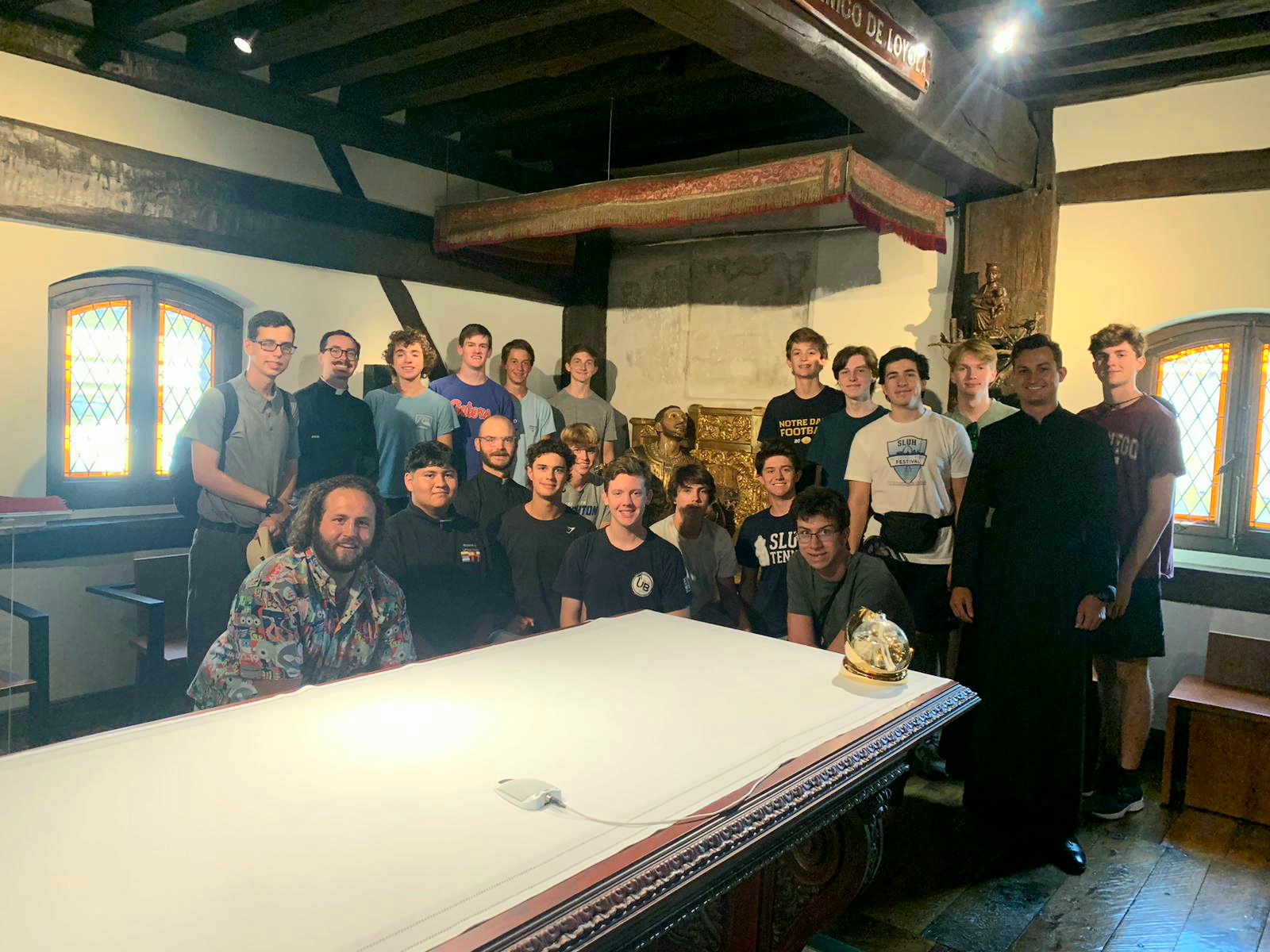
Students and faculty on SLUH’s World Youth Day pilgrimage to Lisbon gather around the statue of St. Ignatius in the Chapel of Conversion in Loyola Castle. Summer, 2023.
When I was a novice, I came across the writings of St. Peter Canisius whom I took as my vow patron. A Jesuit and Doctor of the Church, he wrote one of the first Catholic catechisms and was renowned for his attentive pedagogy. In a time of polarized polemics, no one was outside the boundaries of his love. A quote from Canisius that captured this reality and informed how I wanted to live and teach as a Jesuit was: “The power to benefit and promote the best interests of a single soul is immensely more valuable than the value of the whole world.” This selfless and compassionate love rooted in his experience of God modeled and animated my own care for students, colleagues, their families, and my brother Jesuits during my Regency. If I have had any positive impact on them, it is due to the singular grace and focus with which God has loved me and through which I have tried to love others.
I still remember one of my first weeks teaching at SLUH. A student was sharing his good news from the weekend, and another one shouted, “Y.O.L.O!” I jokingly responded, “Well, technically, as Christians, you’ll live at least twice,” which confused nearly the whole class. While most of them knew that Christ resurrected from the dead, few understood that it also applied to them personally, let alone the implications of their baptisms. I realized then that I was on the frontline of evangelization and that it was in my students’ best interests to scrap my lesson plan for the day. Over the rest of the period, I delighted with them in going down any related rabbit hole spurred on by their curiosity.
Ever since, I occasionally designated moments as “Curiosity Wells” to allow them to explore the faith in terms of what mattered to them. Their questions typically centered around three poles: medieval scholasticism (Can God create a rock He can’t lift?), confessional casuistry (Is it sinful to… But, what if…), and soteriological uncertainties (My uncle’s an atheist; what happens to him when he dies?). Every question, regardless of how silly or serious it was, gave me pause.
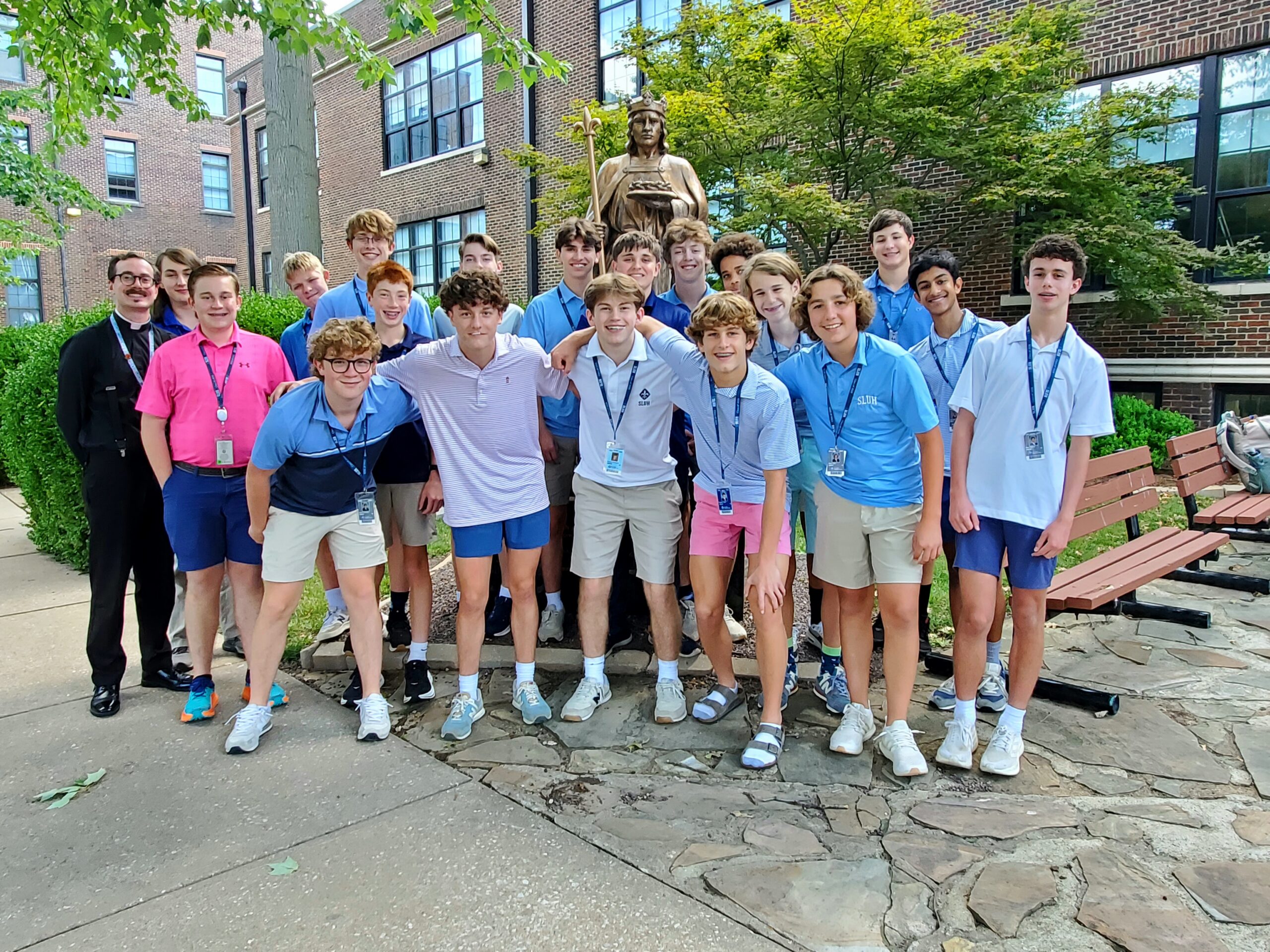
River and a class of his students on the last day of summer school pose in front of the statue of St. Louis, King of France. Summer, 2025.
These young men were probing the intersectional boundaries of logic, morality, and the nature of God and seeing how God and the Church could respond to their quandaries—to them. While I rarely claimed to know the answer and students came to groan whenever I would start my response with, “Well, some say…,” they knew that I cared and would help them grapple with the mysteries of God and life as far as they were willing to go. When I see myself as a priest, these everyday moments of abiding with others in the Lord’s sacred presence come to the fore.
Later, a student wrote me, “At the start of the year, I did not even believe in God. Throughout the year, my reasons for not believing were all disproved in class and from you answering my questions outside of class. Now that I truly believe in God, my life has changed entirely. I wake up happier, with more purpose in my life. The empty feelings I experienced beforehand are gone. Thanks to you, I have become a loyal follower of Christ, and I have a true relationship with Him.” It was not necessarily my goal to convert him or anyone else for that matter at SLUH, but merely to love and support my students where they were while also calling them to move forward with the same love and support that Christ has shown me. Like Canisius, his note reminded me that it is small daily acts of attention that can have the largest impact on a person.
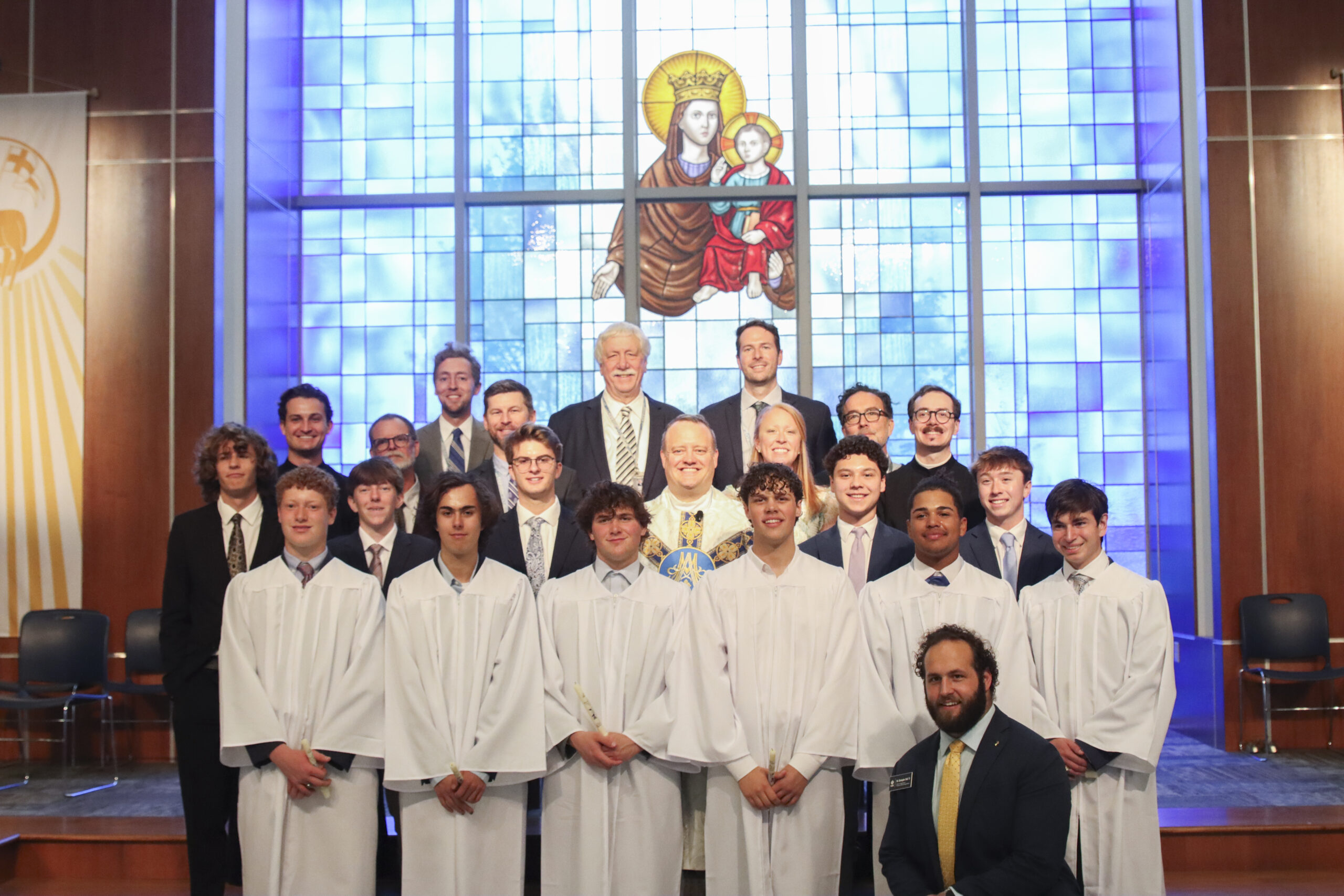
Students received into the Church at SLUH stand with members of the faculty serving as their godparents and sponsors at the final all-school Mass of Praise and Gratitude. Spring, 2025. Courtesy of SLUH.
Truly, God only needs a crack of light to enter and illuminate someone’s world. Our vows of poverty, chastity, and obedience lived out in joy give us the freedom to make those cracks. It might mean that I spent an extra few minutes on an email instead of clocking out for the day or that I may not have had the time to fully explain all the consequences of a globalized food system, but my colleagues and students will remember the love or indifference I showed them far longer than anything I else I may have done.
That, at least, was the ideal in my labors in the Lord’s vineyard. It is easy to love in the abstract and when things are going well. It is a lot harder when you need to hold students accountable for their misbehavior or when you catch them cheating and lying to your face. Yet, Regency teaches you that true grace does not flee from the messiness of real life but leans in. Behind most misdeeds and selfishness is typically just an insecurity or unfulfilled need. Helping students understand the heart of the matter and how to turn back towards God and their community serves as the acid test for whether we have understood the message of the gospels.
Relatedly, a lesson I endeavored to impart to my students throughout our study of scripture was that God does not call the equipped; He equips the called. For example, Moses was a deeply flawed man full of self-doubts, and yet God chose him to lead the Israelites out of slavery and to the Promised Land. Whenever Moses protested his imperfections, God essentially answered, “I will be with you,” and the rest is grace. This may be one of the most basic truths of our faith, but just because something is foundational does not mean it is easy to believe.
In Regency, I doubted myself a lot: some lesson plans misfired, a few students seemed impossible to reach, and occasionally I just put my foot in my mouth. The thoughts, “Was I really the best person for this mission? Wouldn’t someone else have done better?” would hound me in prayer. Thankfully, the only thing more constant in our lives than self-doubt is God. I know that wherever I am sent and whatever I do as a Jesuit, the Lord will be with me and give me all that I need to bring my mission and my vocation to fruition. I need only persevere in faith and trust. As for me, so too for us all.
Ultimately, I am thankful for how Regency reinforced and deepened my relationship with God and His people. Few other orders or seminaries offer men this long-term apostolic experience midway through their formation. While it may add to the already notorious length of our Jesuit formation, it reminds us that all of our learning and labor as priests and brothers are meant to support others on our collective journey with and towards God. Working in the Lord’s vineyard may be messy and complicated, but it is worth more to me than the value of the whole world.
-//-
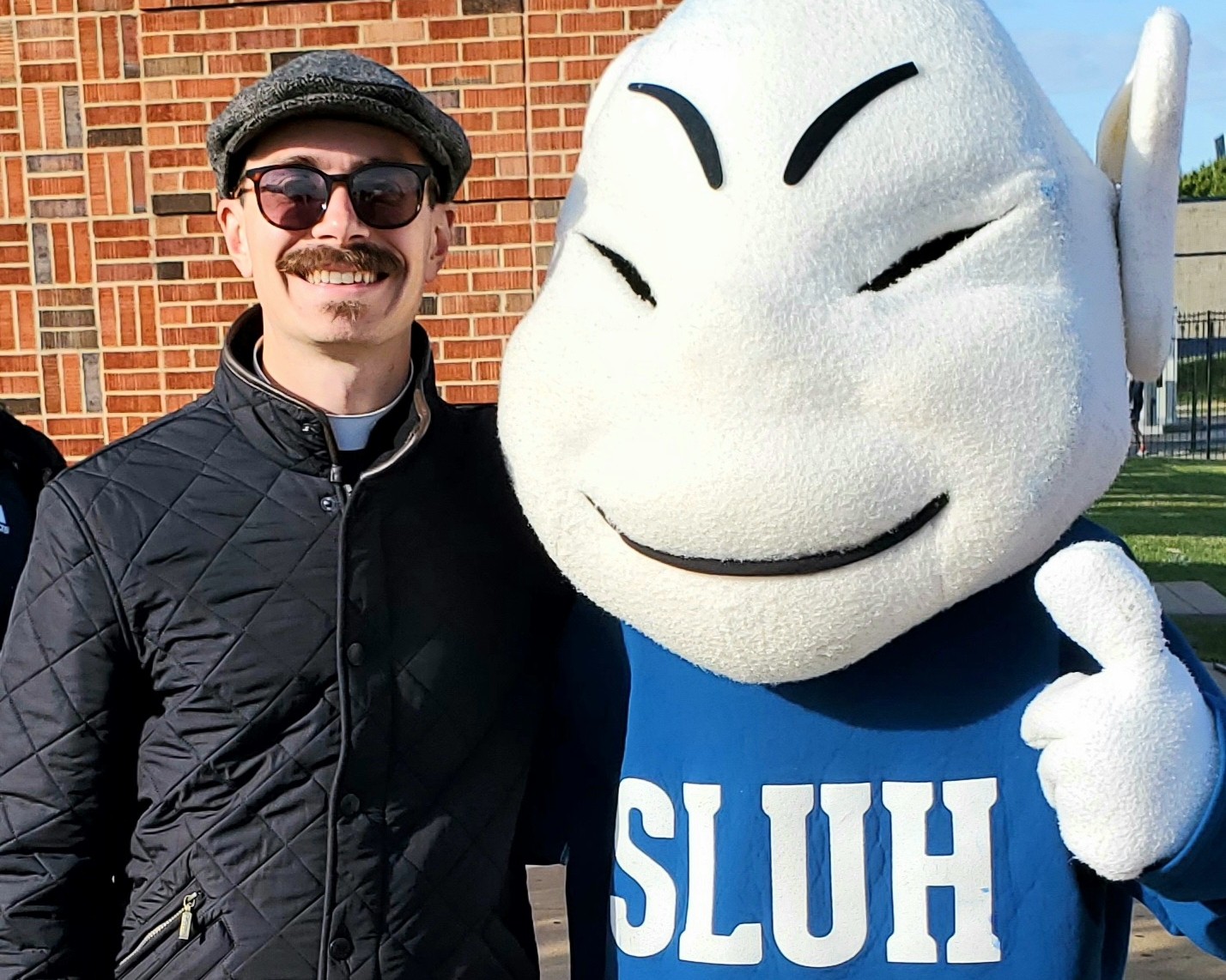
Image: Author with the Jr. Billiken. Courtesy of the author.