
Each month, the Holy Father asks the universal Church to pray for a specific prayer intention. It is a tradition dating back to the papacy of Leo XIII in the 19th century. This month’s Papal intention is “that sports may be an instrument of peace, encounter, and dialogue among cultures and nations, and that they promote values such as respect, solidarity, and personal growth.”
Whether you are an athlete or a fan, all of us are connected to sports in some way. This is especially true now as many of our home countries compete on the global stage in the FIFA World Cup. Sports are often where we make our first friends, experience our first triumphs and losses, and cultivate a spirit of healthy competition and community.
In honor of this month’s Papal intention, I would like to share a bit about the rich history and spirituality of a lesser-known sport that has been important in my life and vocation, the game of lacrosse.
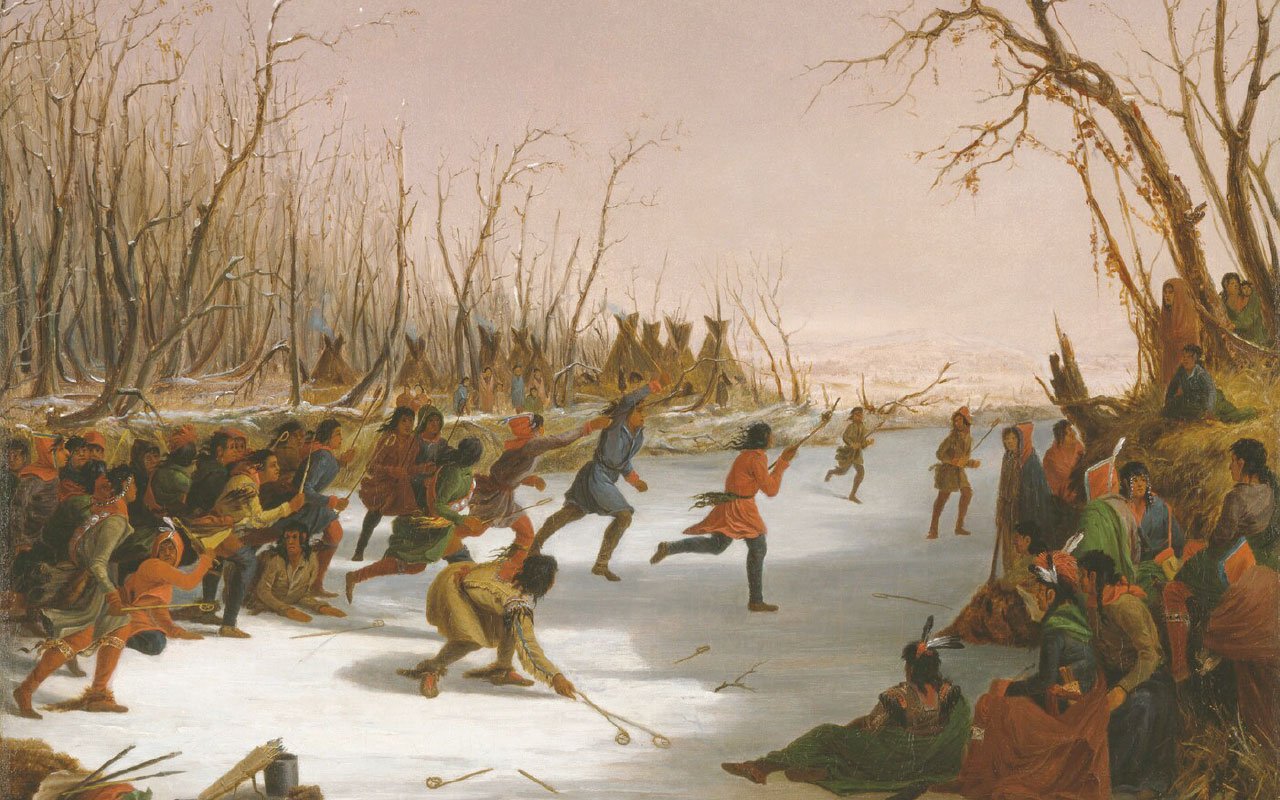
As a middle schooler, I was first introduced to lacrosse in a P.E. class, and it quickly became a passion of mine. I learned that lacrosse originated with Native Americans in the Northeast and is played with a netted stick and a ball. It is often described as a blend of basketball, soccer, and hockey, combining basketball tactics, the soccer field, and hockey’s physicality and finesse.
While Native Americans invented the game, lacrosse’s history has also been influenced by the Society of Jesus. In the 17th century, French Jesuits, including St. Jean de Brébeuf, came to minister to the Natives in a territory then known as New France. Brébeuf observed the Natives playing the game and called it La Crosse (the Crozier) because the stick the Natives used reminded him of a bishop’s crozier.
While the lacrosse stick itself has a religious connection, the sport’s tradition has a much deeper spiritual origin. Native Americans called lacrosse the Creator’s Game and believed that it was played not just for recreation but also to praise and glorify the Creator. Native traditions hold that the game itself was a gift from the Creator, and they believe that, just as a father would take delight in his child playing with a toy gifted to him, so too does the Creator take delight in watching his children play the game.
Learning about the spiritual traditions of lacrosse fundamentally changed how I understood the game. Lacrosse became a source of spiritual pedagogy for me, teaching me that not only my prayers, but also my actions, have the potential to give God glory.
In addition, the simile of lacrosse as a toy gifted by a father enhanced my understanding of God’s fatherhood. When I began to see the things in my life as gifts, I realized that I desired to receive them with gratitude and, in doing so, to glorify God our Father.
As I have progressed in my Jesuit life, the game and spirituality of lacrosse have stuck with me. I have continued to use the sport, of course, for recreation, but also as a way to teach the communities I serve how to understand our lives and the gifts given to us as a means of glorifying God.
Learning more about Ignatian spirituality, I found specific resonance between how the Natives understood the origin and purpose of the Creator’s Game and St. Ignatius’s understanding of living for the greater glory of God–Ad Majorem Dei Gloriam.
The spirituality of Ad Majorem Dei Gloriam infuses every part of Jesuit life. It is highlighted in the missionary character of the order, in the Jesuits’ way of praying, and, most especially, as a foundational concept in the Spiritual Exercises of St. Ignatius.
Two specific moments in the Spiritual Exercises stand out when seeking to unpack the spirituality of Ignatius’s famous phrase Ad Majorem Dei Gloriam. The first comes at the beginning of the Spiritual Exercises in the meditation on the First Principle and Foundation. Here we read that, “all other things on the face of the earth are created for man that they may help him in prosecuting the end for which he is created.”
Ignatius highlights in the First Principle and Foundation that our daily lives, possessions, the Church, and the Sacraments are all gifts from God meant to aid us in our end, which is the praise, reverence, and service of God.
As part of this growing understanding that all things are gifts from God, Ignatius invites the retreatant to develop a sense of indifference. The indifference that Ignatius speaks about is not a blasé indifference but a holy indifference. This is an indifference that embraces the realization that whatever God wills for our life ought to be received with gratitude and used for His greater glory.
After the retreatant progresses through the life, death, and resurrection of Christ, he concludes the Exercises with a meditation known as the Contemplatio. The Contemplatio highlights the same spirit of gratitude presented at the beginning of the retreat. Ignatius writes in the Contemplatio that we “bring to memory the benefits received of creation, redemption, particular gifts… and with this to reflect on myself… what I ought on my side to offer and give to His Divine Majesty.” Thus, as the retreatant concludes the Spiritual Exercises, he prays for the grace to see how all things are gifts from God and ought to be used to glorify Him.
Those who have completed the Spiritual Exercises begin to see the spirituality of Ad Majorem Dei Gloriam as infused by an understanding of gratitude for the gifts we have received, as well as using these gifts as means to give glory to God. This is precisely what the Natives held in mind as the spiritual origin of the game of lacrosse. Just as lacrosse was given as a gift by the Creator and used to praise Him, so too are our lives, vocations, and means that we are given in this world used to glorify God our Creator.
This month, let us join the Holy Father in meditating on the role of sports like lacrosse in our world and draw fruit from the lessons they teach us. Let us pray that we might cultivate a disposition of gratitude so that we may learn to see all things as gifts from God, and use them as means to praise, reverence, and serve Him, Ad Majorem Dei Gloriam.
-//-
Image: Ballplay of the Dakota on the St. Peter’s River in Winter, by Seth Eastman, 1848. Public Domain.