
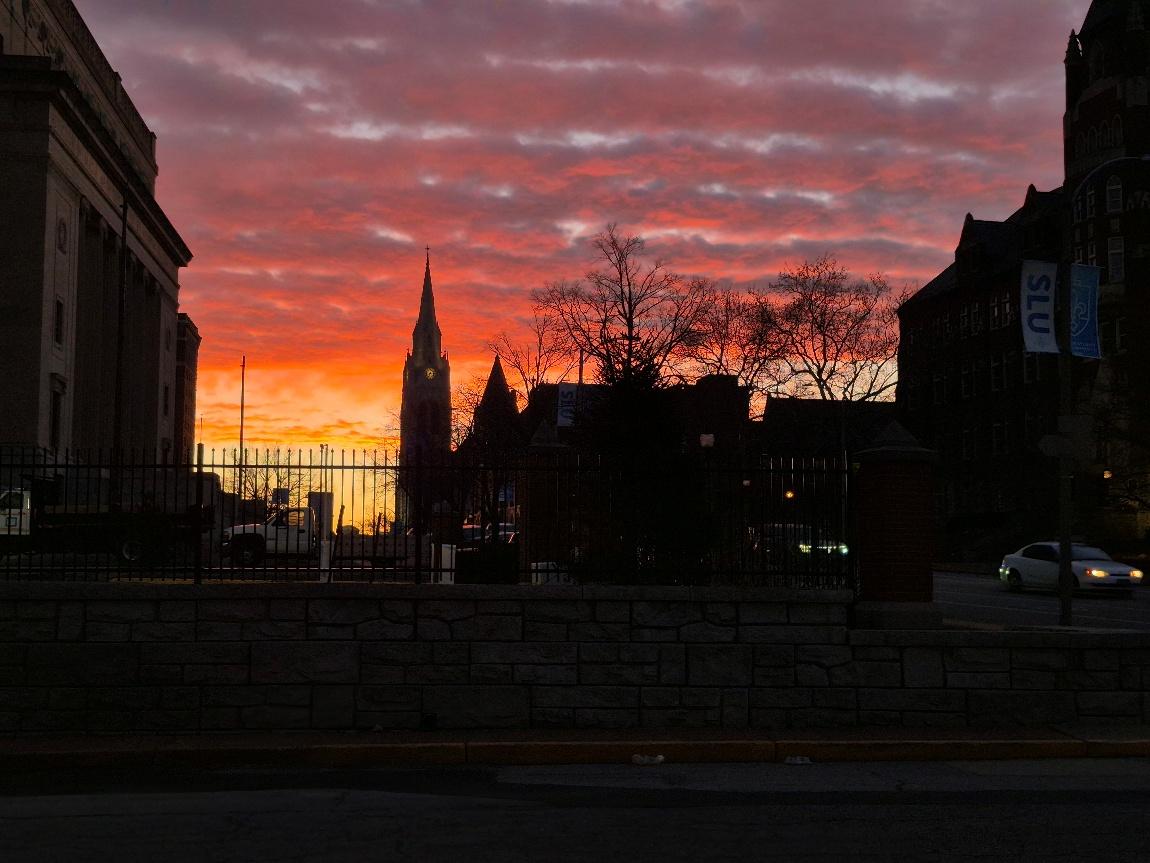
In the United States, Saint Louis University’s Bellarmine House of Studies is one of the two “First Studies” programs (the other, Ciszek Hall, is at Fordham University in New York City). During this stage in formation, Jesuit scholastics and brothers spend two or three years studying philosophy and theology. Some men also pursue other programs to support their academic and ministerial interests.
Upon professing my First Vows in August 2025, I concluded my 2 years as a Jesuit novice and became a scholastic. For the next stage of formation, my provincial (the superior to whom I am obedient) missioned me to study Philosophy at SLU and to live at Bellarmine House. Two days after Vows, I headed to Saint Louis and got settled into my new First Studies community.
Since I studied Economics and Management as an undergrad, I need to complete most of the Philosophy coursework required by the USCCB’s Program for Priestly Formation. All Catholic seminarians, whether they are in a religious order or sponsored by a diocese, must take certain philosophy and theology classes.
I compare these to pre-requisites for Medical or Law School – who wants a doctor that hasn’t at least taken Biology and Chemistry, or a lawyer who can’t write well? From the Church’s perspective, future priests need to study Aristotle, Descartes, and Nietzsche before further studying theology.
My philosophy classes have forced me to grow outside my comfort zone. In my Hermeneutics class, I found that it was a tall task even to understand writers like Martin Heidegger, much less respond to his arguments about the meaning of human existence. As that class stretched me intellectually, it also forced me to generally refine my way of thinking about education.
As an undergrad, I viewed most of my classes for their functional content. Management classes help you learn how to be a good manager, a Microsoft Excel class teaches you how to work with spreadsheets, and a Communications class teaches you how to write and speak. My philosophy classes, though certainly rich in content, offer something more abstract – how to identify what makes a good or bad argument.
These classes have also shown me positive and less-positive examples of pedagogy. Some of my professors lectured for over an hour, while others encouraged us to engage in class discussions. A handful of professors had every reading prepared and posted online by the start of the semester, while others would not post their assignments until right before the due date. Such experiences have given me not just academic knowledge, but the experiential learning of how students see these approaches, which is critical as I prepare for future ministry. These make for memorable lessons, as I remember that my decisions as a minister will not just impact me, but those whom I serve.
The courses have also shown me how to care for people in present and future ministry. My professors have mostly been willing to experiment with different lesson plans. I even had one professor build in relevant clips from The Dead Poet’s Society and Good Will Hunting to better relate to the students in my class. My classes have helped me feel more free to use my creativity on school assignments and in my ministry.
In addition to our full-time class schedule, each Jesuit scholastic and brother is assigned an apostolic ministry site for 6-8 hours of ministry each week. My ministry takes place at a parish in the northern suburbs of St. Louis. Every Sunday, I assist at parish masses and teach weekly 8th grade Confirmation classes.
Recently, I modified one of my Confirmation lesson plans to better accommodate their expressed interests by drawing parallels from Fortnite, Cristiano Ronaldo, and Kobe Bryant. One of my students said, “I was inspired” after we covered his hero in a class lesson. I guarantee he paid more attention after I incorporated his favorite player than if I had just used the standard textbook lesson.
Embracing studies is a concrete way that I live out my Jesuit vocation, and it’s been a grace to recognize the ways that my classes have impacted my prayer. My Biblical Interpretation class has helped me to better imagine scenes of the Gospel when I pray with Ignatian contemplation. I have also noticed how my prayer has moved me more towards action, whether that involves choosing between good ministry opportunities on campus, sharing devotions with my friends and family, or figuring out how to best serve my students. That Confirmation lesson with all those parallels? That was the fruit of prayer on how I could meet the needs of my students.
In short, my classes have helped me become a better Jesuit. They have helped me to learn empathy, openness to growth, and flexibility. I have also come to realize that while I have had good experiences so far in ministry and Jesuit life, today’s classes will prepare me for an even more universal good later on. Through the increased intellectual capacity and interior dispositions of love and obedience, I will be available to minister in more places and better able to engage with those who God is calling me to serve.
St. Ignatius wrote in Jesuit Constitution 361 to remember that in this stage of formation I “cannot do anything more pleasing to God our Lord than to study with the intention [of serving the glory of God and the good of souls].” Even if I don’t use what I studied, “the very toil of study…is itself a very meritorious work in the sight of the Divine and Supreme Majesty.” (Cons. 361). So, for the present and future glory of God, I’ll be hitting the books these next few years here at Bellarmine House.
-//-
Image: Sunrise on the campus of St. Louis University, with St. Francis Xavier College Church in the background. Taken by the author.