
Alleluia, He is Risen indeed!
Now that we have begun the Easter Season, we have 50 days ahead of celebrating Christ’s Resurrection until the arrival of Pentecost Sunday. While Lent can feel like a long haul, Easter, notably, is actually a longer season in the Church calendar than Lent. In Lent, practices like attending Fish Fries and praying the Stations of the Cross help keep Christ’s suffering at the front of our minds. Our Lenten resolutions accompany us as we journey with Christ through the Lenten desert.
Easter presents a different challenge. During the Easter season, apart from singing the “Alleluia” again at Mass, I often find it difficult to maintain a similar level of enthusiasm for the whole 50-day celebration of Jesus’s resurrection.
How can we stay motivated to celebrate the Resurrection for this long? Better yet, how do we continue to dive into the joy of Christ’s Rising from the Dead? A devotion I recently discovered, called the Stations of the Resurrection, has helped me do just that.
What are these “Stations?”
A couple of years ago, I was on vacation in Puerto Rico. In two separate churches I visited, I noticed some paintings hanging up that were numbered 1-14, but which were clearly different from the Stations of the Cross. Intrigued and curious, I spoke with an attendant and she said that they were called the “Stations of the Resurrection.” After researching these Stations, I was fascinated to learn that they are not just in Puerto Rico. The Stations were formally approved by the Vatican in 2001 and can now be found across multiple continents. Surprised that these beautiful devotions were not more widely known in American Catholic circles, I was excited to dive further into their Resurrection narratives.
The Stations of the Resurrection are 14 meditations encompassing the events from the Resurrection of Jesus on Easter Sunday to the Descent of the Holy Spirit at Pentecost. In 1988, Fr. Sabino Palumbieri, a Salesian priest and anthropology professor, proposed these additional scripturally based stations to supplement the traditional Stations of the Cross.
Fr. Palumbieri’s rationale for their creation was that while the Catholic Church does a great job reflecting on the Passion and Death of Jesus, these reflections can sometimes overshadow the equally important Resurrection. Put simply, we often reflect on how Christ suffered for us, but less on how His suffering was redemptive in the Resurrection. The Stations of the Resurrection seek to remedy this imbalance by giving Jesus’ redemption the attention it deserves.
Ignatian Application – Week 4 of the Spiritual Exercises
I invite anyone who has found spiritual fruit in the practice of Ignatian Spirituality or the Spiritual Exercises of St. Ignatius of Loyola to consider spending time with the Stations of the Resurrection. I have found that they offer a profound way to deepen the graces of Ignatian prayer.
For those unfamiliar, the Spiritual Exercises are broken up into 4 “Weeks,” or themes of prayerful contemplations. The First Week focuses on God’s goodness and God’s love for us. The Second Week contains meditations on the life of Jesus and the Call of His Disciples. In the Third Week, the retreatant accompanies Jesus in His Crucifixion and Death, while the Fourth Week focuses on Jesus’ Resurrection. The Exercises contain much of the grounding material of Jesuit Spirituality—things like The Rules for Discernment, The Examen, the idea of the Magis (choosing what better helps us to Praise, Reverence, and Serve God) – all these have their origins in the Spiritual Exercises.
When I made the Spiritual Exercises in my first year as a Jesuit novice, I was reaffirmed in the necessity of both the Crucifixion and the Resurrection. While I was in the Third Week of the Exercises, I spent 7 full days accompanying Jesus through the Passion narratives. As Jesus fervently prayed in the Garden of Gethsemane, I prayed with Him. Even if I couldn’t pay the price for Him, I could be present with him in His time of crisis.
In witnessing Peter’s denial of knowing the Lord, I felt the pain that denial caused both Jesus and Peter. And in praying over the Scourging of Jesus and the Way of the Cross, I understood that Jesus paid this painful price because it was the only way that I might live, that my sins could be redeemed. Finally, I understood the Church’s focus on the Crucifixion, and its importance in my own personal life. Although these Third Week meditations were profoundly consoling contemplations, spending a whole week focused on the passion proved difficult.
When approaching the Fourth Week of the Exercises on my annual 8 Day retreats, sometimes I feel tempted to celebrate, to try to get through the Third Week’s Passion narratives as quickly as possible. After all, once Jesus dies on the cross, the suffering ends. Then the Resurrection happens, and the few Fourth Week prayers can feel “easy” compared to the difficult Third Week. For instance, after you have imagined the blood, sweat, and tears shed by the crucified Jesus, what’s the challenge in praying about the risen Jesus visiting Mary, or Ignatius’s famous Contemplation on Divine Love? Once I was in the Fourth Week, it was a surprising challenge to fully enter the experience. Once Jesus rose, Christ’s mission was accomplished–and more than 90% of the way through my month-long retreat, I almost convinced myself, so was mine.
But the Stations of the Resurrection remind me that the real work has only just begun. John’s Gospel tells us that Jesus spent 40 days on Earth after the Resurrection. On one of these days, he forgave Peter for his denial. Speaking from personal experience, this type of true forgiveness is always easier said than done. For those like the Disciples on the Road to Emmaus, who only knew of the crucifixion and death, it may have felt like all hope was irredeemably lost until the Risen Christ revealed Himself.
After sharing the joy of His Resurrection with others, Jesus empowers the Church to carry on proclaiming this message today in the Great Commission. And of course, we can’t forget the Disciples locking themselves in the Upper Room, praying for 9 Days after Christ’s Ascension for the Holy Spirit’s direction. The Stations of the Resurrection help me stay grounded, drawing off not just the joy of Jesus’ Resurrection but the challenge of persistent discipleship as well.
Through making the Exercises and incorporating the Stations of the Resurrection, I could finally embrace the need for both elements of the Christian faith–the Passion and the Resurrection–in order to really learn about Jesus as the Paschal Sacrifice and True Redeemer.
Growing up, I felt like the Church was obsessed with Jesus’ suffering and death. In the Stations of the Cross, and especially on the crucifix, Jesus was either on His way to die, dying, or had already died. At most, a 15th Station of “Jesus Rises from the Dead” or a Risen Jesus in lieu of a crucifix might have been all that I would see in a Church. Before departing for the Exercises, my attitude was that Jesus’ Resurrection “made up” for His Passion and Death, so it was morose or depressing to not include the Resurrection or focus on it. Following the Exercises, I understand that each has its place–and that like the Passion, the Resurrection has its own spiritual fruits that can move us to better love and serve God by our lives.
The Stations of the Resurrection
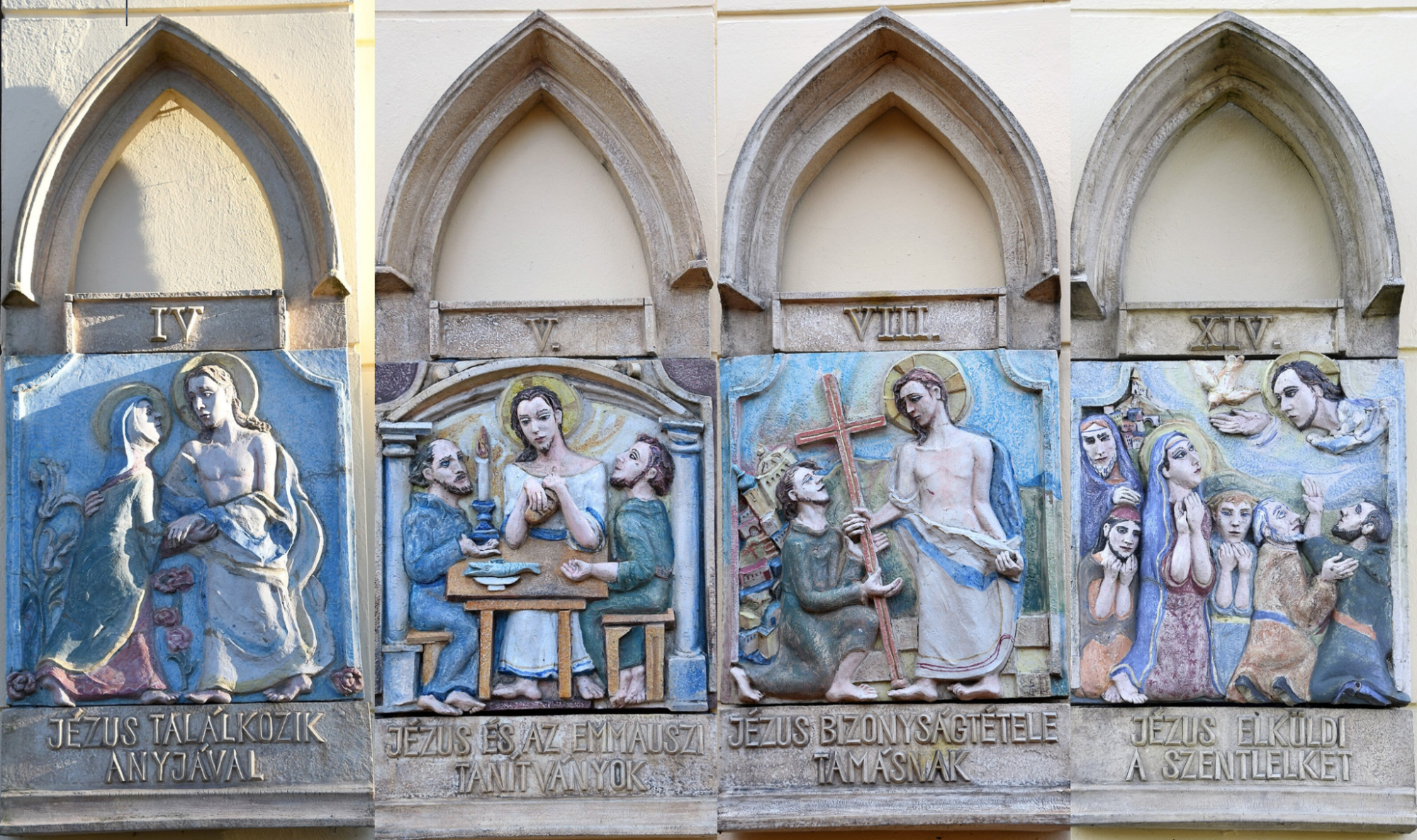
As happened with the Stations of the Cross many centuries ago, the Stations of the Resurrection have spread across the world but vary slightly by local practices in different locations. In Puerto Rico, the Stations are all based on accounts from the Gospels or the Book of Acts. In Hungary, one station is dedicated to Jesus meeting His Mother, which St. Ignatius makes the primary contemplation in the Fourth Week of the Exercises. Still elsewhere, there are stations that feature Jesus appearing to Saul, the Earthquake on Easter Morning, and Mary Magdalene proclaiming the Resurrection to Peter and the Beloved Disciple. This diversity reflects the diverse ways we meet the Resurrected Lord in our own lives.
Jesuit Superior General Jan Roothaan explained to young Jesuits that the Spiritual Exercises are not written about, they are experienced. The same is true of the Stations of the Resurrection—the experience of these Stations will be far more meaningful for you than any words written on a page.
Remember that, like any other form of prayer, God works with each of us in different ways. Some people love the Rosary, others don’t get much out of it. Others cherish the Stations of the Cross to encounter Jesus, while some get bored or turned off from the practice. All to say, if you have a profound experience with the Stations, great—and if not, don’t get discouraged. Either way, rejoice in the knowledge that He is Risen!
–//–
To pray with the Stations for yourself, here is a link to a packet that I used with my students at Saint Ignatius High School in Cleveland, OH, and a video from Our Lady’s Immaculate Heart Catholic Church in Ankeny, IA.
Image: Stations of the Resurrection in Dunaszentmiklós, Hungary. Source: Wikimedia Commons. Public Domain.