
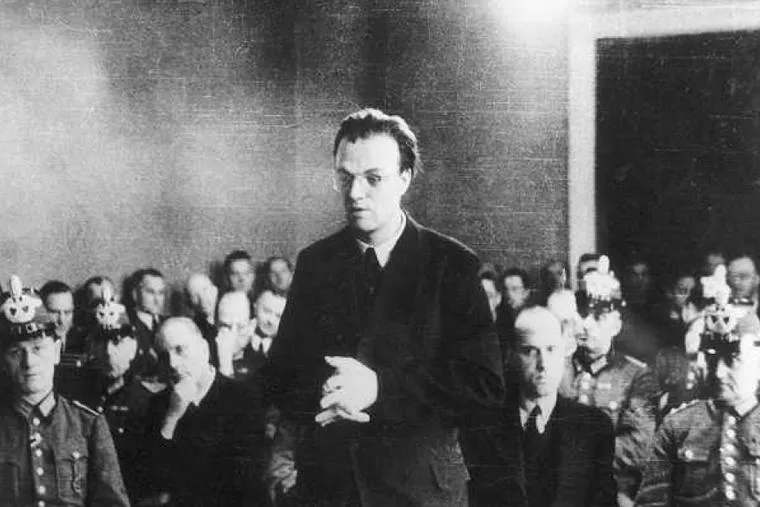
Alongside watching Elf and The Santa Clause for the umpteenth time, I count taking a copy of Fr. Alfred Delp, SJ’s prison writings down from my bookshelf as one of the pillars of my annual Advent routine. For the past several years, since first encountering Delp’s story, I have returned again and again to his words at this season of the year. No matter how many times I come back to them, Delp’s reflections on the meaning of Advent always strike my heart in new ways. This year, that has been especially true in his meditations on trust and hope in God. Delp’s vision of Advent hope is rooted in an acceptance of human limits and how embracing those limits turns us toward God, even when God’s saving action feels hidden.
Fr. Delp was a German Jesuit whose priestly ministry unfolded amidst the violence of the Second World War. Like countless others who endured Germany’s twelve-year self-inflicted catastrophe of National Socialism, Delp found himself on the deadly receiving end of Nazi injustice.
Ordained a priest in 1937, Delp made no secret of his opposition to the Nazi regime and its ideology. He participated in a resistance group promoting Catholic Social Teaching as a model for a future postwar Germany. He was also known to mock the Gestapo informants who attended Mass at his Munich parish. Ultimately, Delp was arrested and sentenced to death for an act of which he was innocent—involvement in the July 1944 plot by several German officers to assassinate Adolf Hitler. Delp had visited with the plot’s main conspirator, Claus von Stauffenberg, earlier that summer, and consequently he was arrested in the midst of Hitler’s paranoid rage the week after the plot’s failure. A sham Nazi “People’s Court” quickly sentenced him to death despite a lack of evidence.
As Delp spent the last months of his life in Berlin’s Tegel Prison during the winter of 1944-45, the reality of facing death informed his final experience of the Advent season and helped him grasp and articulate in new ways the profound spiritual invitation it offers.
Just as the Advent season itself resists easy clarity, Delp’s Advent meditations can be difficult to work through. His prose is dense, and nearly every passage is marked by a remarkable depth, one that tends to stop a reader mid-page. It is easy to spend a whole hour contemplating a single sentence. Try this one on for size, in which Delp speaks of the Advent call to wake up to oneself:
“It is precisely in the severity of this awakening, in the helplessness of coming to consciousness, in the wretchedness of experiencing our limitations that the golden threads running between Heaven and earth during this season reach us; the threads that give the world a hint of the abundance to which it is called, the abundance of which it is capable.”
No doubt Delp was fully conscious of his own mortal limitations as he awaited execution in the Advent season of 1944, but these physical limits brought on by his confinement pressed him to ponder with new urgency the “golden threads” by which God reaches out to the world with hope even in the darkest of times.
In a meditation for the First Sunday of Advent, Delp reflected from his Berlin cell on the difficulty of reconciling the world’s disorder with the promise Advent invites us to each year. Falling bombs do not harmonize easily with Christmas bells, a reality we are as sadly aware of today as Delp was in 1944. Delp insists, however, that we will never be able to fully understand Advent’s “deepest meaning” unless we confront, head-on, the poor prospects we face as individuals and as the human race without God. The message of a coming Day of Salvation will be a sentimental trifle, Delp writes, in the absence of “alarm over the powerlessness and futility of human life in relation to its ultimate meaning and fulfillment.” We must realize our need for God’s intervention before our hope can be placed in the Lord’s coming, in God’s promise to “raise the boundaries of our existence” and overcome the world’s brokenness.
Where I find myself most unsettled reading Delp is in his insistence that we must come to terms with the realities of life in a broken world. Accepting the promise of God’s coming requires acceptance of our basic condition, the fact that our life will and must always have what he terms an “Advent dimension”—the experience of limits, of need, of suffering, of “desert journeying.” But don’t we want the suffering to end? Don’t we want the bombs to stop falling? We naturally answer yes, and so we look for closure through political fixes, technological innovation, perhaps a charitable donation—anything that could offer us a feeling of resolution. Delp does not reject human action, but reminds us that if we truly desire such transformation, such things will not suffice. We must “wake up to ourselves” and turn toward God, the God whose coming our Advent waiting symbolizes.
Delp looks askance at any solution to suffering that turns humanity away from the call to hope in God. There is no “interim finality” between our present state and the Day of Salvation, he stresses. The thought that we can create “final conclusions” on our own is humanity’s “old temptation” to live outside of and deny our true human condition. Indeed, Delp sees the embrace of this temptation as the “existential lie” for which the world he inhabits now does penance. He perceived all too clearly how a desire for “final conclusions” had led to Nazi decisions for final solutions.
It strikes me that Delp penned such words only a few short days before he took his final vows as a Jesuit on December 8, 1944. A fellow Jesuit managed to smuggle the Latin vow formula into a prison meeting with Delp that was supposed to concern legal matters. He reportedly wept as he pronounced his vows, a scene which must surely have confused the attendant prison guard, who did not realize what was taking place. Even before his arrest, Delp’s vows had been delayed owing to other Jesuits’ perception of him as a difficult personality and tensions with his provincial. Delp must have reflected with some amazement on the words from the previous Advent Sunday’s psalm, “Those who wait for you will not be disappointed.”
These vows represented not only the culmination of eighteen years as a Jesuit, but a mark of Delp’s radical trust in God. His vows were a concrete embodiment of refusing the “interim finality” offered by the world that he had written about just days prior. The point becomes even stronger when one considers that the Nazis had offered Delp freedom if he would choose to leave the Jesuit order. He rejected the supposed certainty of the world and chose instead to embrace hope in God.
Delp offers us the comfort of hope in the Lord’s coming amidst the reality of an imperfect world. It is not a naive hope but a certain hope, for we trust that God is already on the way, already at work in manifesting its reality. The full reality may remain hidden from us, but if at times it seems difficult to perceive God’s action, we should not despair. Looking at the Blessed Mother’s role in Advent, Delp highlights that we must always look beyond the immediate reality and search for the light at the edges:
“The gray horizons must light up. Only the foreground is screaming so loudly and penetratingly. Farther back, where it has to do with the things that really count, the situation is already changing. The woman has conceived the Child, sheltered him under her heart, and has given birth to her Son. The world has come under a different law.”
As the world collapsed around Alfred Delp, he certainly knew the screaming of the foreground. He also saw that this disorder is not what really counts. In the anguish of a suffering society, and in the anguish of waiting for his own death, Delp saw the mystery of God and the mystery of Advent hope.
Be shaken, wait on the Lord and trust in the hope of this season. Year after year, Advent shows us that, as Delp teaches, there is always more at work than we could ever imagine. If all you can see is the screaming foreground, take heart and wait. Jesus is indeed on his way.