
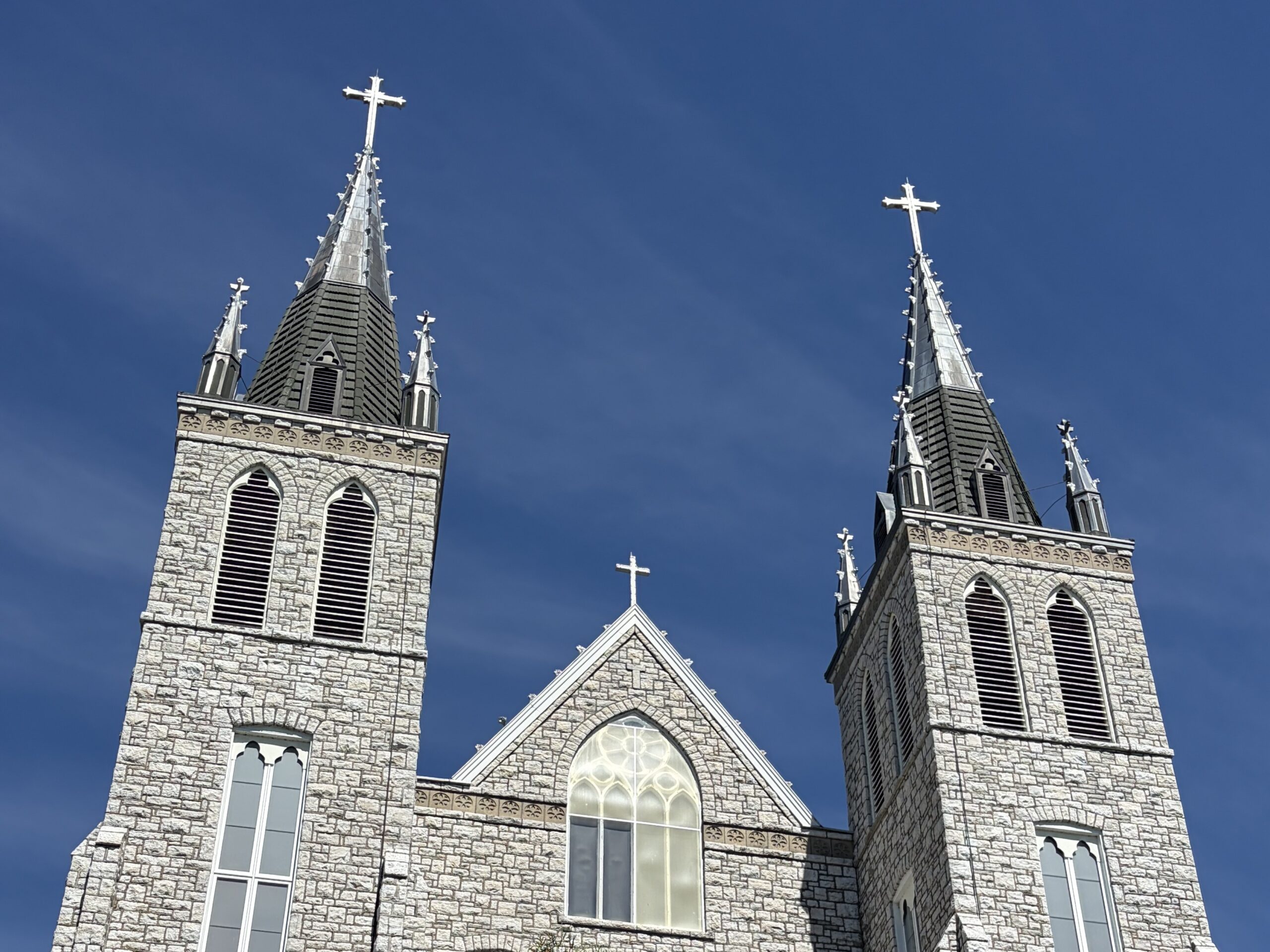
One of the great graces of Jesuit life not only is to make an annual eight day retreat, but to do so in the company of Jesuit brothers. This year, the three of us chose to spend our retreat together at the Martyrs’ Shrine in Midland, Ontario, which sits just above the historic site of the Mission of St. Marie Among the Hurons, and near the martyrdom site of Sts. Jean de Brébeuf and Gabriel Lalemant.
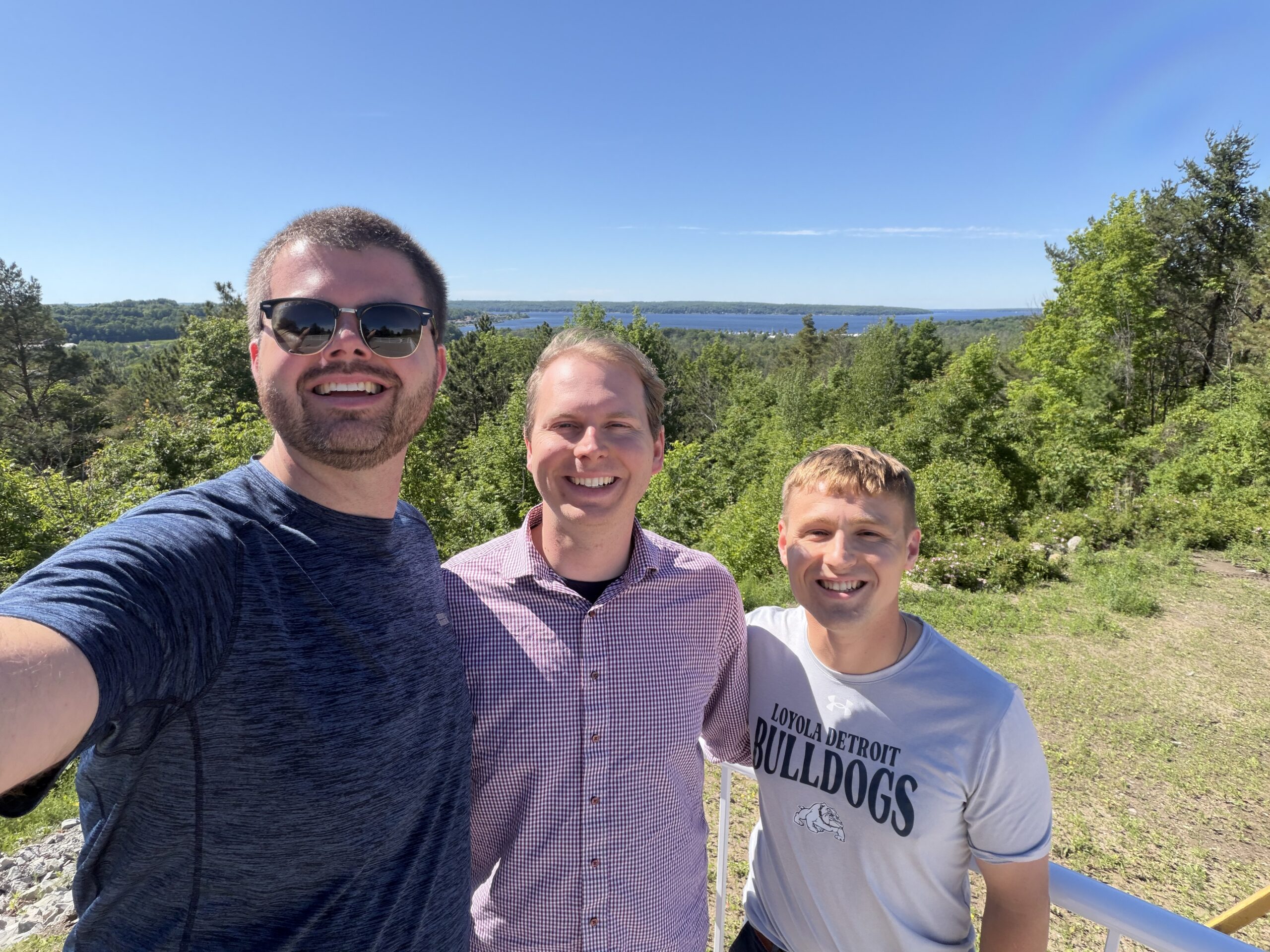
Ty, Nate, and Brennan together on the shrine grounds before beginning their retreat.
We accompanied one another in silence throughout our time at the Shrine. As we found in our faith sharing and conversations following the retreat, the experience of praying in the footsteps of the martyrs affected us and our prayer in differing ways, and we each came forth from the retreat blessed not only with unique graces, but with new perspectives on the North American Martyrs and their story.
In the tradition of Jesuit faith sharing, each one of us offers a grace that we found on retreat and carry forward into our respective missions. In the process of seeing God’s individualized action with each person, those engaged in faith sharing affirm St. Ignatius’ belief that the “Creator [acts] immediately with the creature, and the creature with its Creator and Lord” (Spiritual Exercises [15]).
Nate: Together with Jesus
In the chapel of the school where I teach, two sets of stained glass windows depict the lives of the North American Martyrs. On one side of the chapel are depicted their works, images of Jesuit missionaries canoeing through rapids or preaching the gospel to gatherings of indigenous Christians. On the other side are images of their martyrdoms, their ultimate witness that showed their willingness to unite their own sufferings and deaths to the suffering and death of Jesus.
A couple of years ago, I arrived here to begin my regency, a period of Jesuit formation where we work in a Jesuit apostolate for a few years. I had been assigned work that was unfamiliar to me—I was just beginning as an English teacher. Stepping into the chapel for daily Mass in those first weeks of the new school year, I felt a kinship with the men who stepped into a vaster unknown than the high school classroom. I looked to them as models of accompaniment, prayerfulness, and fidelity. They became companions of sorts as I made my way through the challenges and joys of apostolic life.
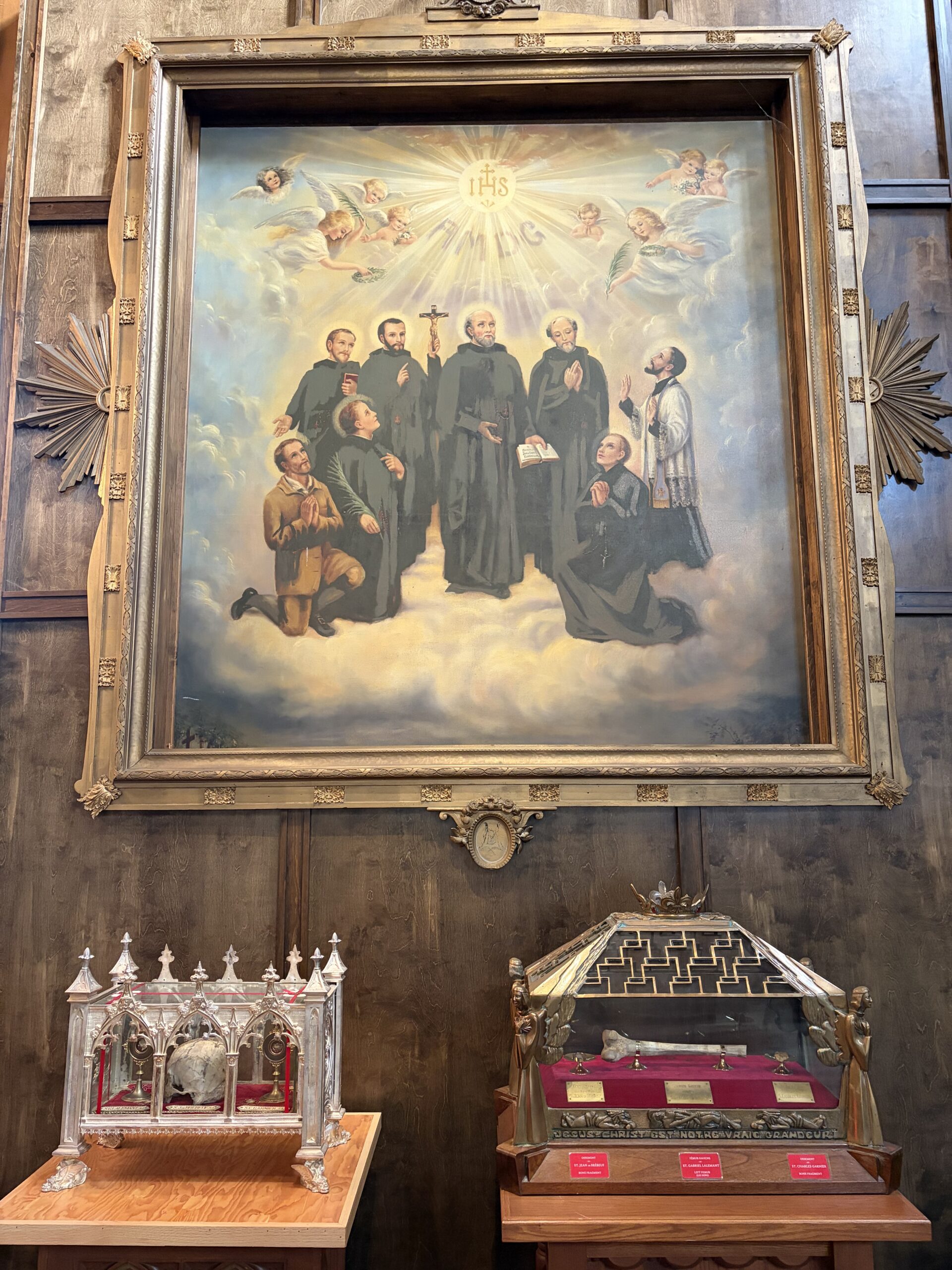
Relics of the North American Martyrs inside the shrine church in Midland.
All of this was on my mind when I arrived at the shrine in Midland for the eight-day silent retreat. It had been a busy and challenging year—I had stepped in as leader of the environmental club and taken on an additional class when a few late staffing changes left the school in a bit of a bind. I came to the retreat tired, uncertain if the quiet would be a reprieve or a difficulty. The evening before the retreat, I sat in the shrine’s church and entrusted my retreat to their intercession, saying to Jesus that I would have the sort of retreat that He would have me make.
This grace of abandonment to God became the central grace of my retreat. I felt a companionship with the martyrs, not out of some vainglorious attraction to their strength and tenacity, but out of a resonance with their deep trust in God. Over and over, I heard God reminding me that our lives are bound together. Whether teaching in the classroom, guiding my students in cocurricular activities, or collaborating with my colleagues, there is comfort in the fact that my life in the apostolate is a sharing in God’s life. We are collaborators in the work of love.
There is one window unlike the others back at the high school where I teach. At the very front of the church, on the left-hand side, is a window that depicts Jesus sending out the apostles. We who have heard the good news have all been sent—in our own ways, to our own frontiers. But God has not left us to work alone. Whether on the shining shores of Lake Huron, the noisy hallways of a Jesuit prep school, or some other vineyard of the Lord, it is the same mission we bear, and the same God who helps us to bear it.
Brennan: Trusting in God’s Providence
Any sensible person can look at a tragedy and say “this should have been different.” For the person of faith, the challenge is to maintain one’s trust in God’s providence amidst such reflections. I encountered this grace while praying in the footsteps of the martyrs.
Part of our assigned reading as novices included the writings of the North American Martyrs, and I have frequently turned to them for spiritual reading throughout my formation ever since. As is often the effect of places marked by holiness, their stories feel different when you stand in the very woods where these men once labored.
At the beginning of the retreat, my director gave me a copy of Fr. Paul Rageaneau, SJ’s Shadows Over Huronia to accompany my prayer. A collection of his reports on the mission over the course of several years, Fr. Rageaneau’s words drew me into the visceral suffering that marked life for the Jesuits and their Wendat converts.
Today, it’s difficult to come close to even the mundane difficulties they faced. Early in the retreat, I jogged out to the former site of Mission St. Louis, where St. Jean de Brébeuf, SJ was captured. I went intending to spend some time there in prayer before continuing onto the actual martyrdom site further down the road. Within barely a minute of arriving and being immediately bloodied by a mosquito swarm, my plans were swiftly abandoned. I wondered how Brébeuf had once managed to accomplish his work in these conditions.
Of course, the events at St. Marie took on a far bloodier veneer than mosquito bites. The peaceful Georgian Bay community surrounding the Shrine today belies the hundreds of violent deaths from enemy attack and starvation that once occurred on those same shores.
To read the mission history is to attempt to come to terms with the unimaginable degree of suffering that the Wendat endured. As I closed Fr. Raganeau’s book, all I could think was “this should have been different.” I could look with admiration at the people’s faith and the missionaries’ fidelity to their vocation, but still, it should not have ended in the tragic way it did.
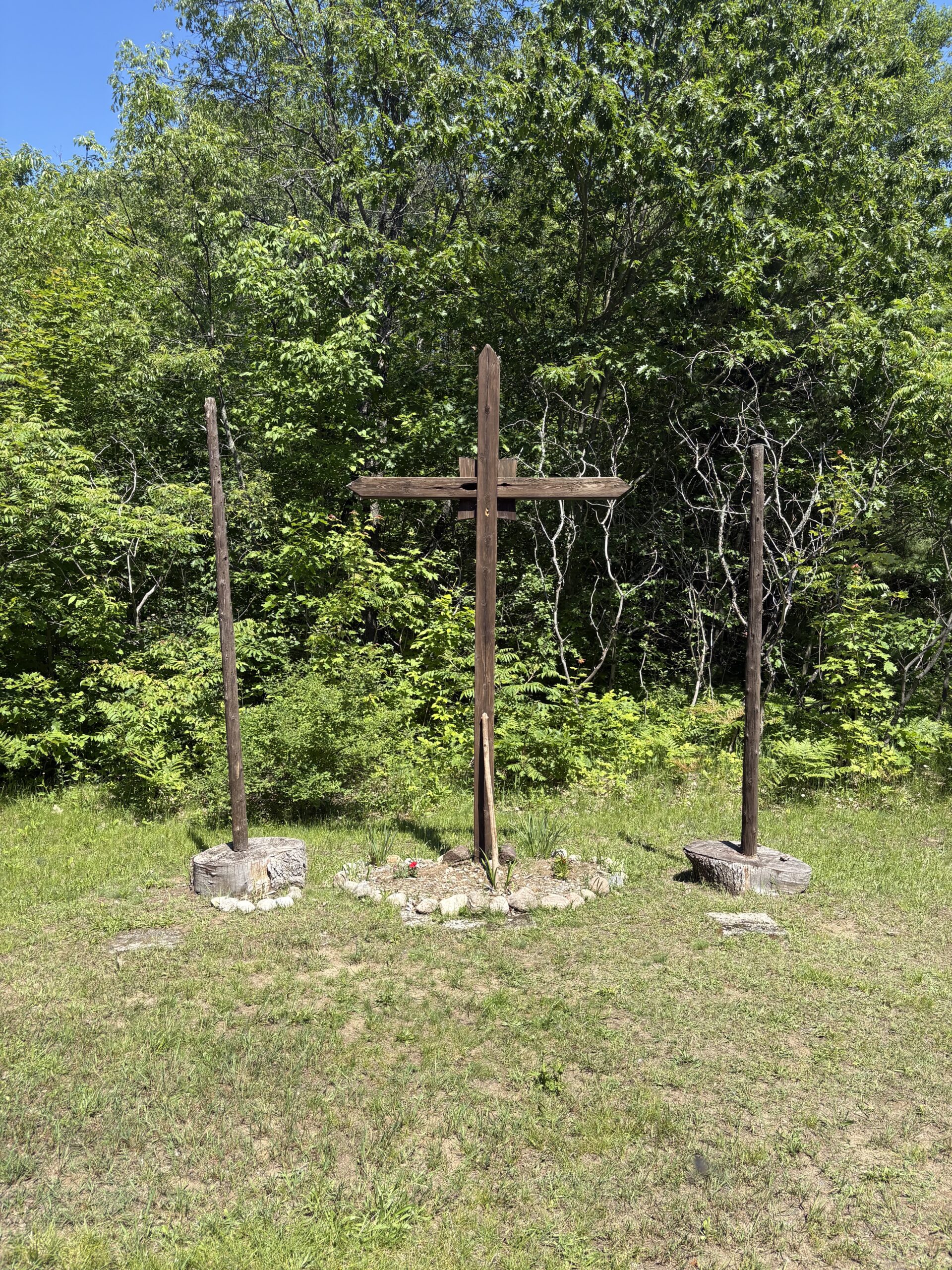
The memorial cross at St. Ignace II, the site of the martyrdom of Sts. Jean de Brébeuf and Gabriel Lalemant.
Twice I visited St. Ignace II, the forest grove where Fr. Brébeuf and Fr. Lalemant suffered their infamously brutal martyrdoms. Many miles removed from the highway, it is a place of profound beauty. But even more so, it is one of profound and even haunting silence. I struggled to reconcile its beauty with the suffering it once witnessed, but sitting there alone, taking in the quiet, the nature, and the lone wooden cross marking the site, it was difficult not to feel God’s tangible presence.
Things should indeed have been different for the Mission of St. Marie Among the Hurons. Those who made their life around the mission should not have suffered the way they did. While some of the Jesuit missionaries knew that martyrdom was a highly realistic possibility when they departed Europe, I would not venture to say that God actively desired them to endure all that they did. Things should have been different.
And yet, the peace that abides there today speaks to God’s providence. Even when things should have been different, we can trust that God was still leading the way. Even when we rightly wish things were different, as the Jesuits and Wendat of St. Marie surely did, we can still trust in God’s design. Amidst many other graces during eight days of prayer, I continue to be grateful for the reminder the martyrs’ story gives me that God’s vision is greater than my own.
Ty: Redirected Back to My Mission
After we had embarked on our eight-day period of silence on the first evening, I walked up to the crest of the hill overlooking the shrine grounds and the southern tip of Georgian Bay. As I marveled at the tree-lined hilltops sparkling in the golden rays of a northern summer sunset, I marveled too in awe at the history surrounding me: the famed Jesuit missionary St. Jean de Brébeuf and his companions had walked these very woods. My mind was racing with romantic daydreams of how my Jesuit path might cross with my forebears’ paths in these coming days.
I imagined, quite naively, that God might completely redirect my future as a Jesuit. Inspired by how readily these French Jesuits risked their lives—crossing to lands unfamiliar to Europeans, learning an unwritten language, enduring freezing winters and blazing summers without the comforts of contemporary life—I thought God might call me to similarly bold endeavors.
But that call never came. Instead, what surfaced in my prayer was the faces of the students I teach. I recalled various impactful conversations with my adult colleagues. God highlighted my growth in recent years on my road to priesthood, and I saw that God’s grand plans for me were not in some galaxy far, far away. Rather, God redirected my focus and renewed my zeal for the work already before me.
It only dawned on me several weeks after my retreat that this is often God’s invitation at every Mass. After all, my mission as a Jesuit and the Mass share the same Latin root: missio — to be sent. Just as the Father sent Jesus into the world as the ultimate sign of God’s love, so too is the Jesuit—and indeed every Catholic—sent to manifest that love in their own context. Was this not also the mission of St. Jean de Brébeuf and his companions?
In my corporate career before I entered the Jesuits, I often found myself contemplating various other career choices. Despite finding great consolation and confirmation in my calling as a Jesuit, I was surprised by how often I would consider various paths within this vocation. The grace of this retreat reminded me that, ultimately, it does not matter where I am or what I do. I have one lifelong mission as a Jesuit and as a Catholic.
Amid the mundane tasks of grading student assignments or responding to never-ending emails, my focus on this mission can drift. No wonder my imagination filled so quickly with romantic daydreams once I could set the minutiae aside and walk in the footsteps of these great missionaries. However, no matter the job, city, country, or galaxy, my mission is the same: to manifest God’s love to those around me. The particularities of my context shape how that mission unfolds, but the principal calling itself remains.
-//-
Cover photo: Shrine Church in Midland, ON. All photos courtesy of the authors.