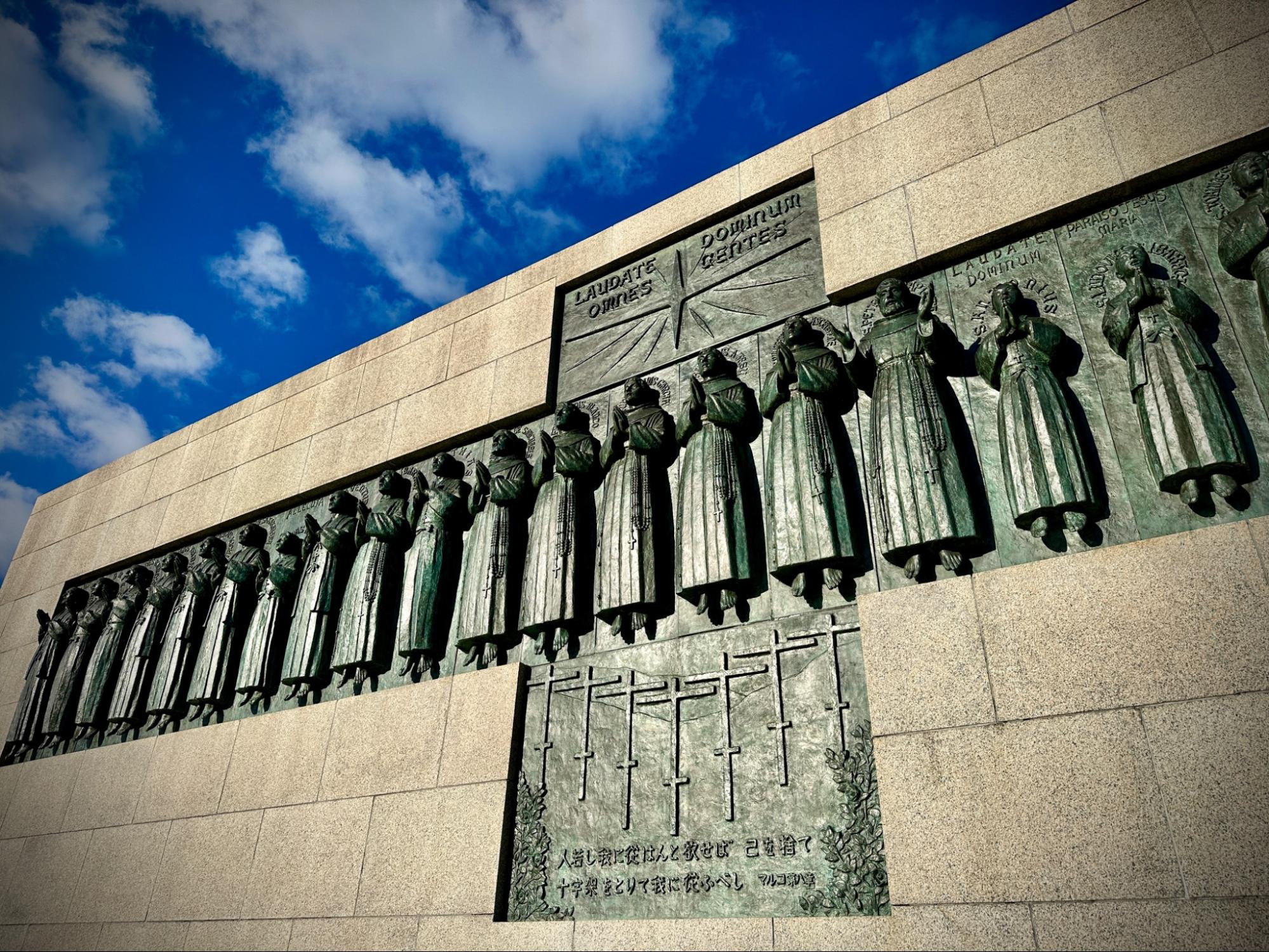
On February 5, 1597, Paul Miki and twenty-five others were bound to crosses and impaled with lances atop Nishizaka Hill in Nagasaki, Japan. Nagasaki was a bustling trade port, and the hill commanded an auspicious view of the bay. It was intentionally selected as the site of execution as it was hoped that news of the martyrs’ fate would be circulated as widely as possible by the many visitors to the city.
The martyrs’ final ordeal atop Nishizaka capped off a torturous month-long sojourn spanning hundreds of miles. Following their sentencing in Kyoto, each captive had their left ear cut off to mark their public humiliation as condemned criminals. They were then forced to march hundreds of miles on foot to Nagasaki while being paraded through local towns and villages along the way. Lacking adequate food and clothing for much of the journey, they endured the bitter chill of winter as they slowly made their way to the city where they were condemned to die.
The execution of these first Christian martyrs in Japan marks a critical flash point of political tensions that had been simmering for some time. St. Francis Xavier, the first Christian missionary to arrive in Japan, landed in Kagoshima on the Feast of the Assumption just a few decades before in 1549. Despite some initial challenges, Christianity began to grow rapidly in Japan. Many estimates place the Japanese Catholic population at around 300,000 souls by 1597. Despite its growing popularity, however, some prominent political leaders were less than enthusiastic about the rising influence of this foreign religion.
Perhaps foremost among these was the warlord Toyotomi Hideyoshi, the de facto ruler of Japan at this time. Through long years of military campaigns and skillful political alliances, Hideyoshi managed to consolidate unified control of Japan. There are several reasons for Hideyoshi’s intense animosity towards Christianity. For one, he saw it as a destabilizing threat to the centralized authority he had established for himself. The egalitarian beliefs of the Christians were diametrically opposed to the top-down authoritarian regimes of the Japanese warlords. Hideyoshi also harbored deep suspicions that European powers could use Christianity as a tool to undermine Japanese sovereignty.
The first major edict against Christianity was promulgated by Hideyoshi in 1587, ten years prior to the arrest and execution of the twenty-six martyrs. Although this edict ordered the expulsion of foreign missionaries and the renunciation of Christian faith by all daimyō (local lords), the edict was not universally enforced. Some of the daimyō were sympathetic to the Christians and others were loathe to part with their lucrative trade connections. As such, many of them initially turned a blind eye to the Christian communities that fell under their jurisdiction.
About a decade later, however, events finally came to head. In 1597, a Spanish trading vessel, the San Felipe, ran aground near Shikoku. When Hideyoshi seized the vessel and interrogated the crew, the pilot reportedly made remarks to the effect that the introduction of Christianity commonly preceded Spanish conquest. Enraged at this seeming admission of his suspicions, Hideyoshi ordered the arrest and execution of several prominent missionaries and their collaborators.
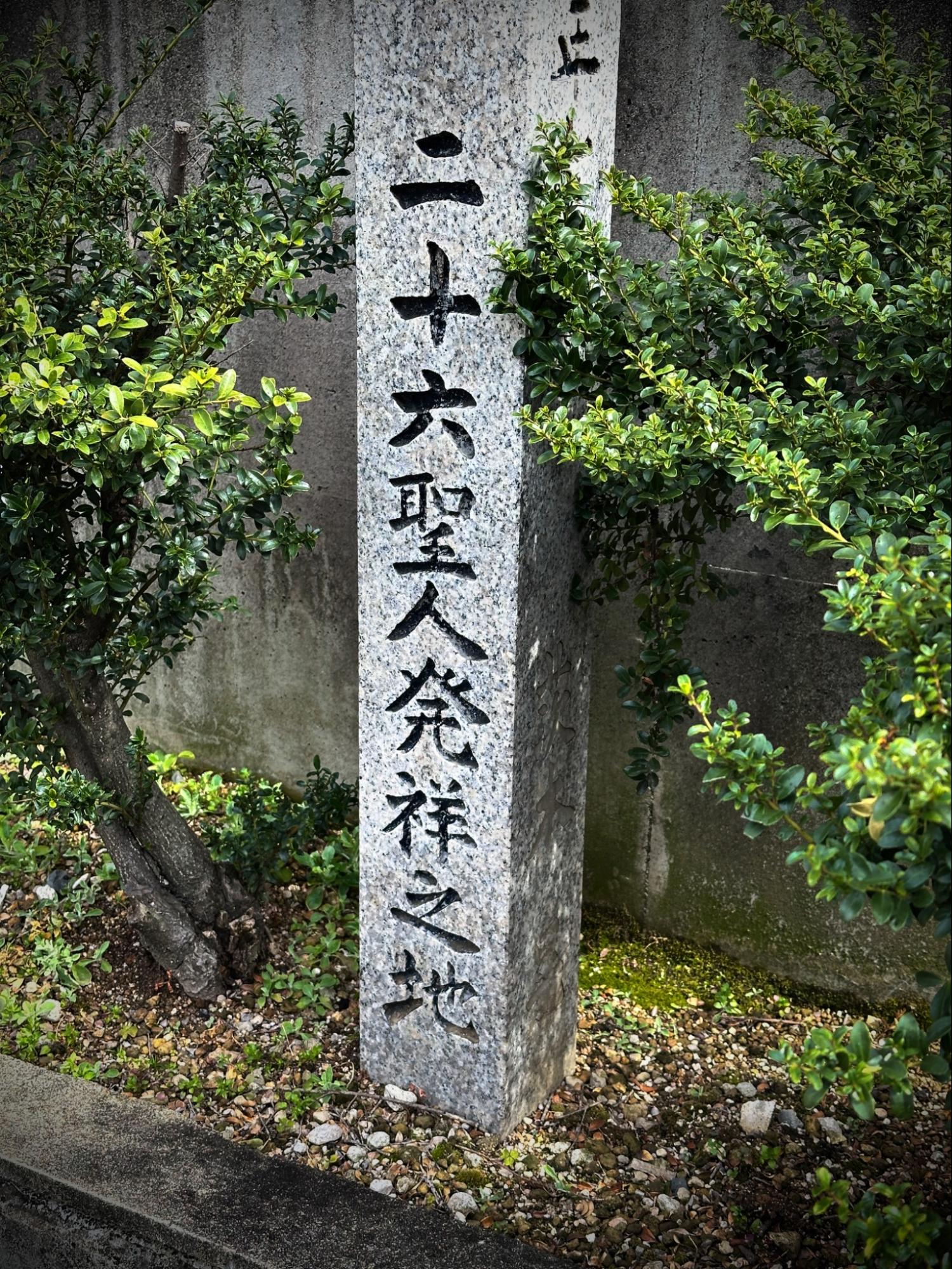
A memorial marker in Kyoto designates the spot where the martyrs began their march to Nagasaki.
Authorities initially apprehended twenty-four individuals in the Kyoto-Osaka area: three Japanese Jesuits, six Franciscan foreign missionaries, and fifteen Japanese laymen. Three of these were boys who frequently assisted as altar servers. After a hasty trial and sentencing in Kyoto, the group endured a month-long march to Nagasaki. Two others would be added to their ranks as they passed through Shimonoseki, thus increasing their total number to twenty-six. Despite the brutal treatment they endured, numerous records indicate that the jubilant spirits of the martyrs could not be subdued. Throughout the journey, their captors were unable to deter them from singing hymns of praise to God even as they plodded through rough terrain amidst the throes of Japanese winter.
Paul Miki had been born into a samurai family and was well-educated even before entering the Society of Jesus. He was close to ordination at the time of his death, and was already a renowned preacher. He preached daily to his fellow companions, and his final sermon would be delivered from the cross in the moments leading up to his execution in Nagasaki.
Miki’s companions were no less joyful or zealous, however. Louis Ibaraki, age 12, continued to sing even as his left ear was being cut off. Thomas Kozaki, age 13, and his father, Michael were together in the group. The following lines come from a letter Thomas wrote to his mother while en route to Nagasaki, and speak to the depth of his personal conviction:
With the help of the Lord’s grace I am writing these lines…You should not worry about me and my father Michael. I hope to see you both very soon, there in paradise… And bear in mind that everyone in this world has to come to an end, and so strive so that you will not lose the happiness of heaven. Whatever men may impose on you, try to have patience and show much charity for everyone.
When the captives arrived at Nishizaka after weeks of walking, they each were bound to a cross. The boys in particular were offered a last chance to renounce their faith and go free. All of them refused, however, stating that they would much rather die than give up their faith in Christ. In the moments before his death, Paul Miki offered the following words as part of his final sermon:
I have committed no crime, and the only reason why I am put to death is that I have been teaching the doctrine of Our Lord Jesus Christ. I am very happy to die for such a cause, and see my death as a great blessing from the Lord. At this critical time, when you can rest assured that I will not try to deceive you, I want to stress and make it unmistakably clear that man can find no way to salvation other than the Christian way. The Christian law commands that we forgive our enemies and those who have wronged us. I must therefore say here that I forgive Taikosama (Hideyoshi). I would rather have all the Japanese become Christians.
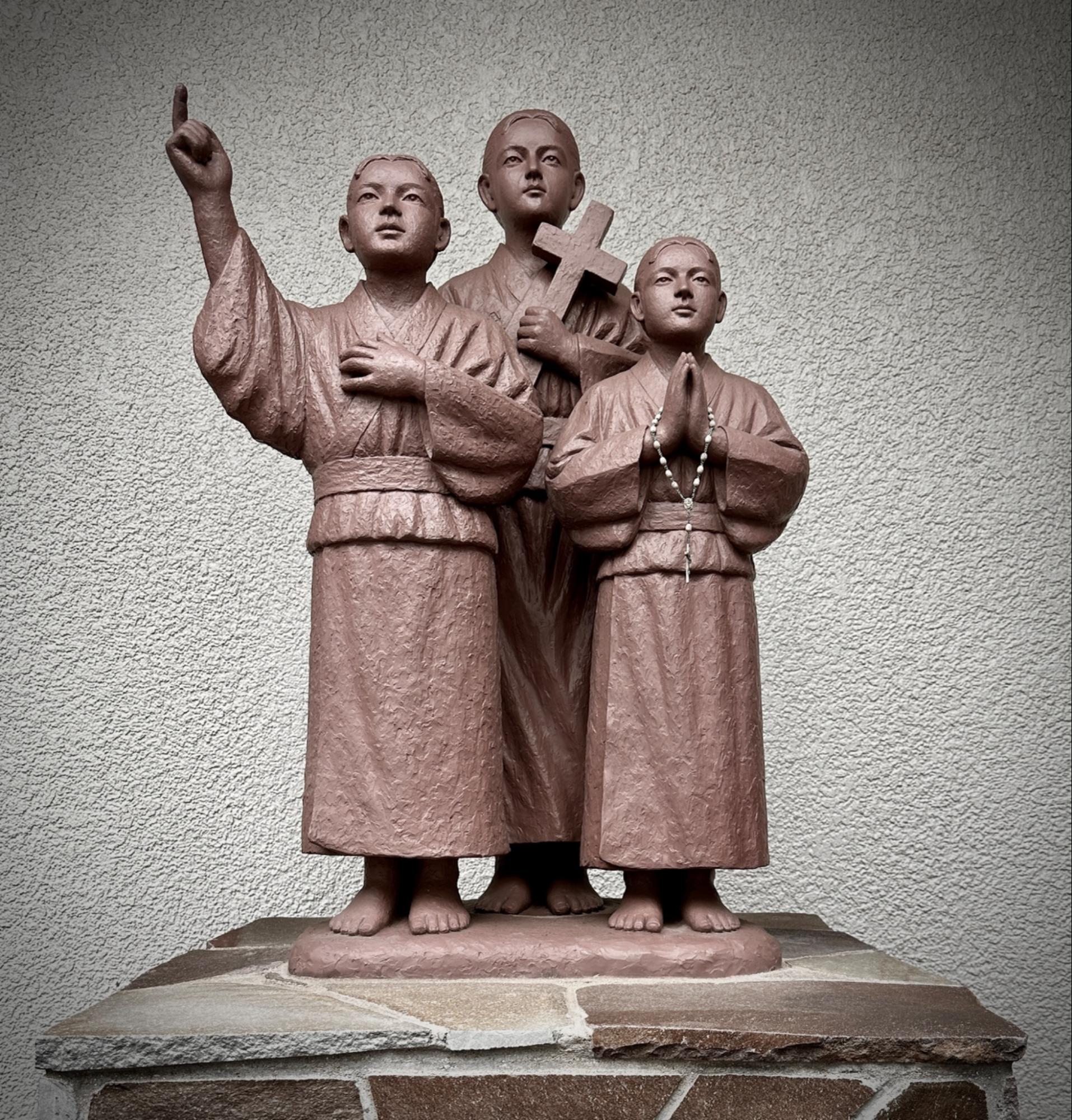
A memorial to the three boy saints Thomas Kozaki (14), Anthony of Nagasaki (13), and Louis Ibaraki (12). This memorial stands outside of Nakamachi Catholic Church near Nishizaka.
Shortly after pronouncing these words, the twenty-six were lanced with spears. Their bodies were intentionally left hanging from their crosses atop the hill for some days afterwards to serve as a warning that Christianity would no longer be tolerated by the ruling regime. More than 400 years later, Nishizaka is currently home to a shrine and memorial museum where pilgrims come daily to pray and honor the beautiful, faithful witness of these men.
While admittedly easy to get caught up in the often gruesome or macabre details of the stories of the martyrs, it is also essential for us to step back and take stock of the true significance of what they have to teach us. Through the centuries, so many of the martyrs have faced unspeakable ordeals, trials, torture, and intense suffering with seemingly superhuman patience and serenity. And it is critical for us to understand why.
The word “martyr” originally comes from the Greek mártus, which means “witness”. More than anything else, the significance of the martyrs is their witness. Not to the terrible treatment that they received or the pains that they endured, but rather to the total interior transformation that has taken place within. They are ordinary people who have allowed the extraordinary, infinite love of God to utterly transform them.
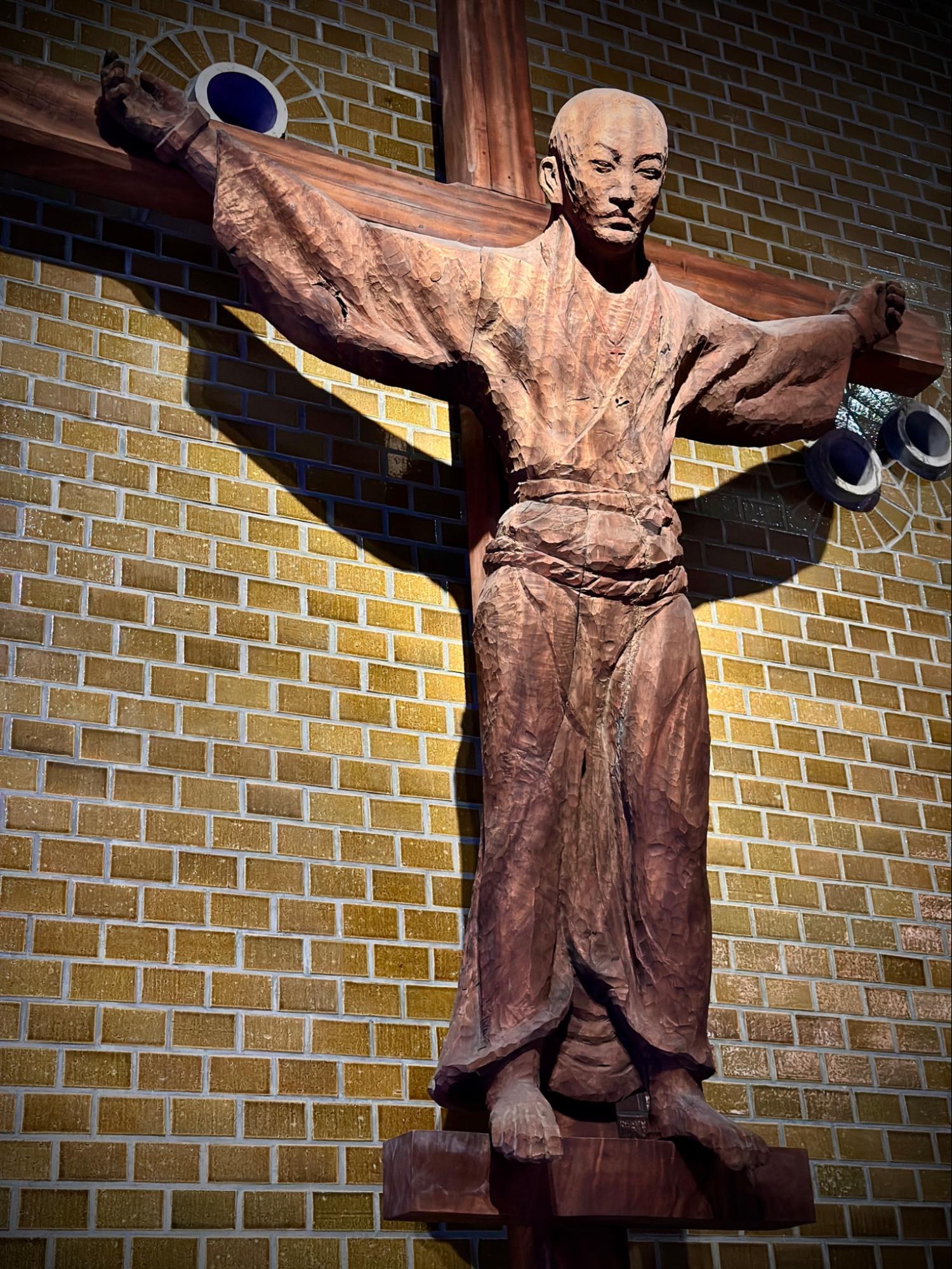
A wood carving of St. Paul Miki by S.Sawada (1962) that is currently housed in the 26 Martyrs of Japan Museum in Nagasaki.
In so doing, they have arrived at the simple truth that the created purpose of the human person is to live in union with God for all eternity. Through continued personal prayer and experience, they have come to the practical understanding that nothing else could ever possibly satisfy them. From this perspective, even the most seemingly extreme personal sacrifices of the martyrs become piercingly logical. After all, why would any rational person ever trade an infinitely fulfilling eternal treasure for any other fleeting thing that could never hope to truly satisfy them?
The martyrs are not superheroes or masochistic lunatics who have carelessly thrown their lives away. Rather, they have found the pearl of great price. They are simple people who bear witness to a simple truth: that God alone can satisfy the deepest, most innate desires of the human heart. And while most of us today may not ever face the extreme trials endured by Paul Miki and his blessed companions, we are called to share in their witness. Each day, we too are invited to allow the power of God‘s infinite love to transform us utterly. And each day, we too are invited to go out and bear witness to a world that is so desperately in need of God‘s infinite love and mercy.
Special thanks to Fr. Renzo de Luca, SJ, for his continued generosity, guidance, and brotherhood. Fr. Renzo is a historian and current curator of the Twenty-Six Martyrs Monument and Museum in Nagasaki.
–//–
All photos taken by the author.