
Do not say, “Why were the former days better than these?”
For it is not from wisdom that you ask this.
— Ecclesiastes 7:10
1. What a Time to Be Alive
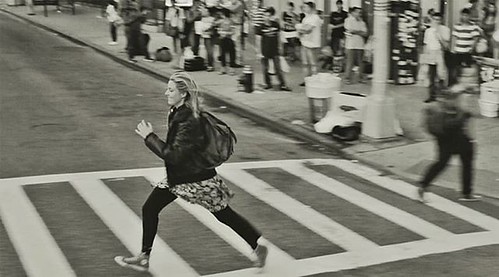
There is a brief scene in Greta Gerwig’s 2012 film Frances Ha where the protagonist, Frances, runs through the streets of Chinatown. She’s headed for her friends’ apartment where she happens to be crashing until she can get her own place. The mood is somewhere between manic and joyful as she leaps, twirls, and dodges pedestrians along the crowded New York sidewalks. Frances’s floral print sundress billows around her and David Bowie’s “Modern Love” blares in the soundtrack. As a 15-year-old in 2012, this is sort of what I imagined my mid-20s would look like.
A nostalgia for that positive, carefree spirit of the early 2010s—sometimes dubbed millennial optimism—has made its rounds on the internet over the past few months. A lot of the posts toe the line between being earnest and tongue-in-cheek. One TikTok features a man running open-armed on the streets of Brooklyn while The Middle East’s “Blood” plays in the background. The onscreen text reads “What I imagine being a millennial living in 2012 Williamsburg felt like.” Another is simply captioned “I wanted that new york apartment with brick walls so bad” as a montage of hipsters in beanies, coffees in mason jars, and skinny-jeans-clad twenty-somethings flashes by.
Beyond the aesthetic, it isn’t hard to imagine more tangible appeals of the era. The 2008 financial crisis was in the past and the seemingly interminable wars in Iraq and Afghanistan were coming to an end. The Lumineers and Chance the Rapper were on the radio, and their music was sincere. Even the newly elected Pope Francis appeared on the cover of The New Yorker smiling and making a snow angel. The internet promised connection and information that was unthinkable a generation before, and there didn’t seem to be any downsides to it.
This website, The Jesuit Post, began as a millennial enterprise in that 2010s internet milieu. It was started in 2012 because, as the first editor-in-chief, Paddy Gilger, SJ noted, “Take a look around the web, it’s everywhere (seen Simmons’ www.grantland.com, anyone?).” It promised a spiritual counterpart to Gawker media run by idealistic young Jesuits in training. I was a wide-eyed high schooler at the time and read its articles in between taking Buzzfeed quizzes and chuckling at the latest Onion headline. God was cool, and online. This was the internet before the pivot to video, before most internet users were mobile, before The Algorithm, before A.I., before words like “doomscroll” and “bedrotting” and “brainrot” had made their way into everyday conversations. These were the before times.
In our frustration with our own time and place, it’s easy to think of the past as not only different, but better. We can ask ourselves whether we were happier or more fulfilled ten years ago in the face of difficulties today. But whether or not the internet, let alone the world, is a better place than it was a decade ago is not the right question. “Bad times! Troublesome times!” St. Augustine proclaims in a sermon on the Gospel of Luke. “This men are saying. Let our lives be good; and the times are good. We make our times; such as we are, such are the times.” And fair enough, good bishop: we are the times. We could all put on skinny jeans and delete our TikTok accounts and grow well manicured beards and binge-watch Broad City, but we know that the aesthetic of it all wouldn’t fool us. It isn’t the appearance we’re after; it’s the feeling.
3. Spes Non Confundit!
A new calendar year is beginning, but at the same time, the Jubilee Year of Hope draws to a close. Hope, as Pope Francis describes in his papal bull Hope Does Not Disappoint, is radically different from optimism. What optimism promises in a future that seems easy and instagrammable, the dream of a perfect night out or a well-curated playlist, hope promises is in a future that is real and a future that is ours. Optimism is fun, optimism is temporal, optimism is a dream that is too small and too late. Hope overwhelms, hope is frightening, hope is a wide open space where reality rushes in. Optimism often disappoints, when the song is done and the trends are passé. Hope never does.
As Pope Leo XIV has said, “The victory of life is not an empty word, but a real, tangible fact.” Hope may be a thing with feathers, but it is certainly a thing with wounds. Hope has a human face and bread in His hands. Hope is a theological virtue. Hope looks at the world and says that it is good. Hope is the dream that we had when we were young. Hope is the kingdom of God, justice and peace. Hope is making the long walk home. Hope is Jesus.
For Pope Francis, this is the central promise of the Christian life: “I will live forever in the love that does not disappoint.” Many things besides it do. You will never be a 23-year-old living in a Brooklyn apartment in 2012. Or, if you were once, you will never be again. But that isn’t what all of the longing on the internet for those times is after, not really. What we are all after, even as the folksy stomp-and-holler reaches a fever pitch, is to belong, is to know that things will be alright, is to trust that what is coming next is good. As the psalmist writes, “Many say, ‘May we see better times! Lord, show us the light of your face!’ But you have given my heart more joy than they have when grain and wine abound.” This, in any time, is a sure, good thing.
And so, ahead of us stretches another year. We are reminded that it is this day, this time and place that is really ours, no other. Here, in the sacrament of the present moment, as Jean-Pierre de Cassaude, SJ would have it, is where God comes to meet us. Here is an invitation to trust, not in the certainties and familiarities of the past, but in the hope of the present. To seek this grace is an invitation to the truest kind of hope, a hope not based in what anyone, even God, has done in the past, but who God is for us right now.
-//-
Image: Frances Ha (2012), directed by Greta Gerwig. Public Domain.