
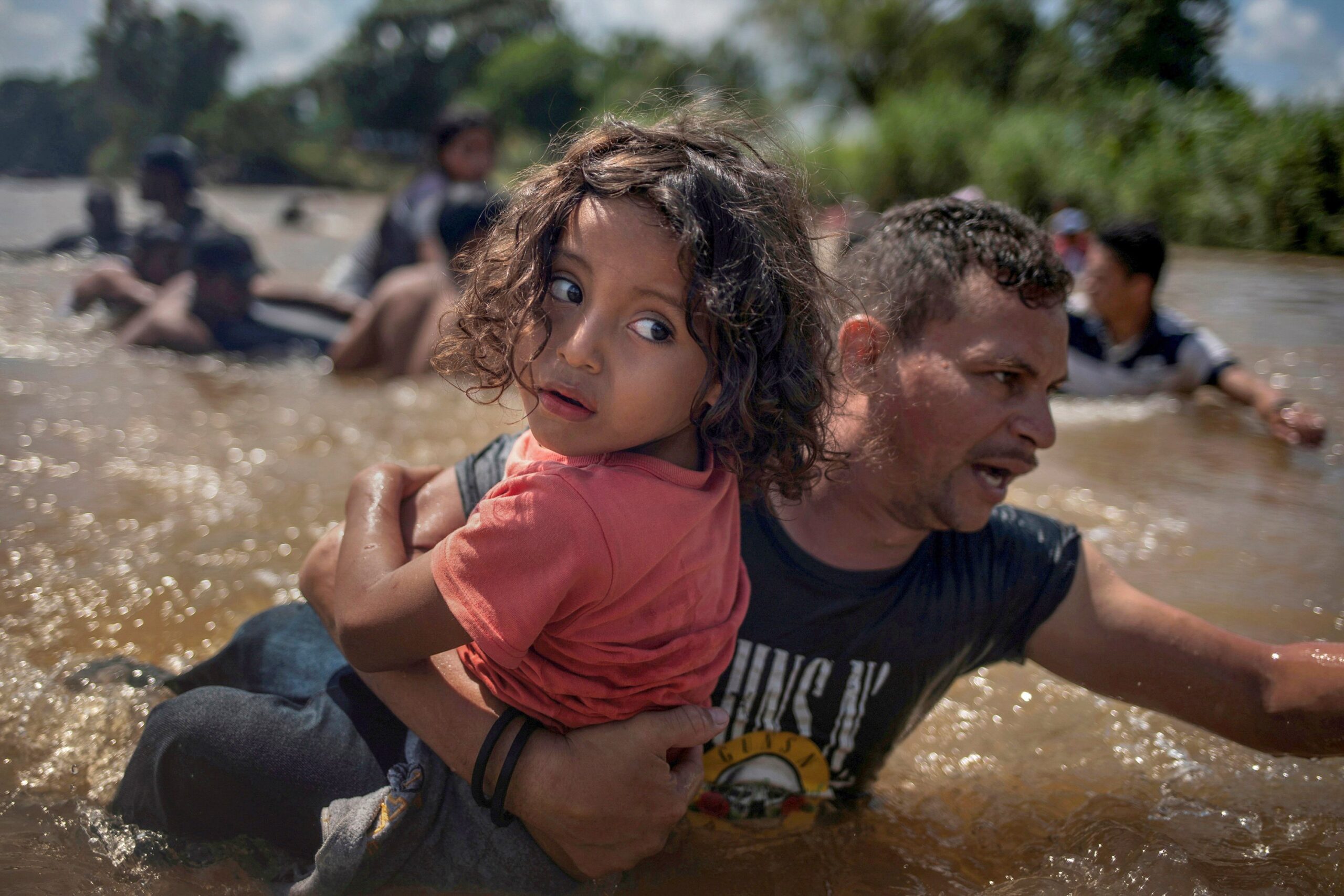
Before they were debunked as A.I. hoaxes, videos on TikTok and Instagram of Catholic bishops denying ICE agents entry to churches were posted and reposted—something of a viral hit. The supposed bishops in the video are angry. They gesture wildly, sometimes wielding bibles or a crozier, shouting while their pectoral crosses swing freely in front of them. They appear real, not just because of the unsettling verisimilitude that A.I. tech is now able to produce, but because they show something that many Christians would hope to be true: the Church stands up for the least of our brothers and sisters, shepherds lay down their lives for the flock.
The truth is that there have been several real instances of this already, in small ways, across the country. For several days in the fall, Catholics gathered outside of an ICE detention facility in Illinois to celebrate mass and to attempt to distribute communion to those incarcerated there. (They were denied this.) In my own city of Detroit, this past July a group of laity, priests, and religious processed to the ICE offices downtown with a letter seeking an end to their brutal tactics and dehumanizing practices.
For the Christian, this is not a policy debate but a moral imperative. It is not of God to reject the migrant. Pope Leo, in his first apostolic exhortation, Delixi Te, states this plainly: “The Church has always recognized in migrants a living presence of the Lord who, on the day of judgment, will say to those on his right: ‘I was a stranger and you welcomed me.’” Here Jesus offers no qualifiers, no exceptions, no easy way to make a case for distinguishing between legal and illegal means. It is, at least in this way, a hard saying. The temptation to respond to the stranger, the foreigner, or the other in fear or anger can be great.
But to follow Jesus is to reject fear and anger and to instead accept His promises of hope and reconciliation. Here in Dilexi Te Pope Leo is again clear—Jesus who comes to us in the person of the migrant, the refugee or the asylum seeker is someone to be accepted and loved. He writes:
The Church, like a mother, accompanies those who are walking. Where the world sees threats, she sees children; where walls are built, she builds bridges. She knows that her proclamation of the Gospel is credible only when it is translated into gestures of closeness and welcome. And she knows that in every rejected migrant, it is Christ himself who knocks at the door of the community.
Here Pope Leo lays out a dream for the possibility of deeper communion, for companionship and solidarity, for hope that walls of ignorance and hostility might give way. His hope is that hardened hearts might soften. This is a real hope, one that is not based in halfhearted platitudes or political scheming. Instead it is a hope rooted in truth and an earnest commitment to doing right by one’s neighbor, whomever that neighbor is and wherever that neighbor happens to come from.
The strife in our city streets, the senseless and unprovoked violence that has resulted in the deaths of innocent people, the separation of spouses from each other and children from their parents, the refusal of basic legal protections and human decency, the dehumanizing and degrading language from the mouths of politicians and the accounts of influencers, the hatred and vitriol and lies—who can say that any of this is of God? It seems futile to scroll through video after video online, to read article after article of commentary, vainly searching for some possibility of hope or decency. It can seem that any good news, any hope for change or peace is an impossibility, a fantasy.
But the Gospel cannot be outdone. This is the good news that migrants bring to us: in each encounter with them we have another chance to love God. We have been given a chance, in our own time and place, to place our gifts before the newborn King in Bethlehem, or to offer Him a drink of water from our own well, or to wipe His face on the way to Calvary. Migrants evangelize because, in them, we meet Jesus again, anew. He stands at the door and knocks, with nothing to offer but Himself.
I know this hope that Jesus brings because I have lived it. For three years, while I was in first studies, I made my home a Jesuit community in the Bronx, in a neighborhood where almost all of my neighbors were immigrants. I bantered with my barber just down the block, a man from the Dominican Republic who patiently slowed down his Spanish so I could keep up with his explanations of why his Yankees were better than my Reds. For lunch, I stopped in at an Albanian place for a slice of hot burek and a friendly chat with the proprietor, a member of the local parish like myself. On weekday afternoons I passed time with a women’s group at that same parish where we made plans for a community garden and learned guitar and drank lots and lots of coffee. Some of the best students I have ever had were 60-year-old abuelas in my ESL classes determined to learn English so that they could speak to their grandchildren. At the Easter Vigil in the neighborhood parish, five languages (Latin, English, Spanish, Italian, and Albanian) were used in the celebration. The community that came to life in just a few city blocks was a vibrant place of belonging, a home for everyone for whom home had once been somewhere else.
Pope Leo traces this in his message for the 111th World Day of Migrants and Refugees as he writes that “the communities that welcome them can also be a living witness to hope, one that is understood as the promise of a present and a future where the dignity of all as children of God is recognized.” What I experienced through these relationships was a renewed sense of my own dignity. I am not the Good Samaritan or the hero of these little stories. I am simply a follower of Jesus who was shown more grace and mercy than he deserved by a God who came to him in his immigrant neighbors with hope, generosity, and love. May the day come when we open every last door that we have to receive Him, as unworthy and yet as loved as we are.
—
Photo License: CNS photo/Adrees Latif, Reuters