
We live in a disenchanted world. We do not think much about non-material realities in today’s age. Except for colloquially uttering “touch wood” without knowing its intended use, most people do not believe in spirits hiding in trees or food. Evil possibly entering us through the things we touch, places we visit, or the food we eat does not concern us.
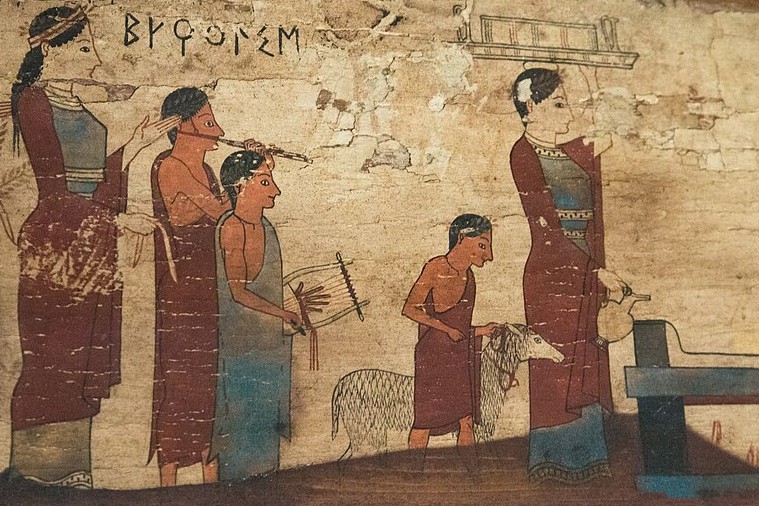
That was not the case for Saint Paul. He admonished the Corinthians for consuming food from idol worship because of its demonic character. In the ancient world, most of the meat at feasts and at the marketplace were leftovers from temple sacrifices offered to Greek gods. Paul was concerned about the spiritual wellbeing of the Corinthian Christians because they were freely participating in worship of other gods through consumption of such meat.
Worship of other gods was a recurring sin of the Israelites over the centuries, and Paul was determined to stamp out such tendencies from the fledgling Christian community. In 1 Corinthians 10, Paul compares the Corinthians’ consumption of idol meat with Israel’s idolatry in the desert. The Israelites had participated in sacrifices to the Canaanite gods and had eaten their food. As a result, God punished them by destroying twenty-four thousand of them (Numbers 25:9; 1 Corinthians 10:8). Such is Paul’s aversion to idolatry that 1 Corinthians 10:14 can be considered to be the key verse of chapters 8-10: “Therefore, my beloved, flee from idolatry.”
Some scholars argue that Paul was only concerned about eating in the presence of idols during the pagan rituals. And so, the Corinthians could avoid the charge of idolatry by eating idol meat outside the context of rituals. However, other scholars suggest that Paul would have believed idol food to be saturated with a “contagion of demons” just as the meal of the Lord (Eucharist) infects the food with the Lord’s blessing. One may compare demonic possession to bacterial infection; one would not consume food infected with bacteria without proper purification. One may even wonder if such food could ever be entirely purified. If sacred food still held sacred powers after the rituals, wouldn’t demonic food also hold such residual demonic powers?
Others counter that having the correct internal disposition while eating could avert the charge of idolatry. After all, Paul seems to suggest that any food was permissible as long as one was consuming it with thanksgiving to God: “So whether you eat or drink, or whatever you do, do everything for the glory of God” (1 Corinthians 10:31) However, it is unlikely that Paul would agree to this line of thinking. One could justify doing all sorts of immoral things by “directing it in thanksgiving to God.” Participating in idolatry, even if done with an internal disposition towards God, is by definition opposed to worshipping the true God. No amount of internal separation from an evil act justifies participation in such actions.
Finally, Paul seemed to be open to the idea that ignorance is bliss. Presumably, if one did not know whether the meat was idol meat, one could safely consume it. “If an unbeliever invites you and you want to go, eat whatever is placed before you, without raising questions on grounds of conscience.” (1 Corinthians 10:27). Paul does not require a Christian to go to unreasonable lengths to track the origins of the meat. However, scholars suggest that the vast majority of meat then available was idol meat. Therefore, a person’s operating assumption should be that it is likely demonic idol meat and thus abstain.
The Corinthians could have done a risk-benefit analysis by applying the idea of Pascal’s Wager to the situation. For instance, if your lunchmeat probably has salmonella, with the penalty of consumption being severe illness while the benefit being a minor gastronomical delight, the decision to avoid that meat is rather straightforward. Similarly, if the meat is likely to be idol meat, and the penalty of eating idol meat because of its offense to God is death while the benefit is a minor gastronomical delight, the decision to abstain from such meat seems rather straightforward.
Western Christians today do not wonder or need to inquire if their meat has been offered to idols before it arrives on their plates. However, other issues with the origin of meat ought to give us pause. Most of the meat we consume today comes from “demonic” factory farms where animals are treated horrendously. If demons are entities opposed to God, then things opposed to God’s kingdom of “righteousness, peace, and joy in the Holy Spirit” (Romans 14:17) have a demonic character. As people of God, we do not want to be dining on demonic food, do we?
The animal agriculture industry today is especially egregious in operating with anti-Christian values. The conditions on factory farms that produce almost all of our animal-based foods are devoid of any compassion for the animals who spend their entire lives in miserable conditions. Large-scale carbon emissions from animal agriculture (by some accounts, more than all transportation sources combined) lead to climate change that adversely affects the lives of the global poor. Animal agriculture is also the leading cause of deforestation and water pollution on a global scale, indicating a lack of respect for God’s creation. Furthermore, slaughterhouse workers doing the dangerous work of slaughtering thousands of animals each day pay the price of physical and psychological injuries.
Meanwhile, consumers eat their meat in willful ignorance while externalizing the true cost of their food to these tortured animals, marginalized farm workers, and God’s creation at large. Food that involves such wanton and unnecessary violence is demonic given its opposition to God’s kingdom of justice, peace, and joy.
If food carries with it spiritual realities through its origins, then the demons of violence of our meat sources will haunt our plates and our bodies. Even if Christians consume such food with an attitude of thanksgiving to God, it would not absolve them of their sins. As Malcolm Muggeridge mused “How is it possible to look for God and sing his praises while insulting and degrading his creatures?” One cannot be thankful to the merciful and compassionate God for the foods that cause misery to untold numbers of animals and slaughterhouse workers.
Living for God’s kingdom has had its challenges in every age. Paul’s proclamation that “if food causes my brother to sin, I will never eat meat again, so that I may not cause my brother to sin.” (1 Corinthians 8:13) is much stronger than it sounds to us. Most meat in his time was sourced through idol worship, and participating in civic life almost always involved dining on such idol meat. In effect, Paul was asking the Christians in Corinth to effectively become vegetarians and to distance themselves from the wider pagan culture. It would be similar to living a vegan lifestyle in America where almost all the meat, eggs, and dairy comes from factory farms. Such was the extent of the countercultural nature of early Christianity.
Living in the kingdom of God is about seeking justice, peace, and even sacrifice, in order to oppose the demonic forces that prowl around our world 一 including the meat in our plates. As Saint Paul exhorts us, “Test everything; retain what is good. Refrain from every kind of evil.” (1 Thessalonians 5:21-22)
Image Accreditation: Painted wooden plaque, procession to sacrifice, 540–530 BC by Zde and National Archaeological Museum, Athens, via Wikimedia Commons, licensed under CC BY-SA 4.0. Cropped from original.